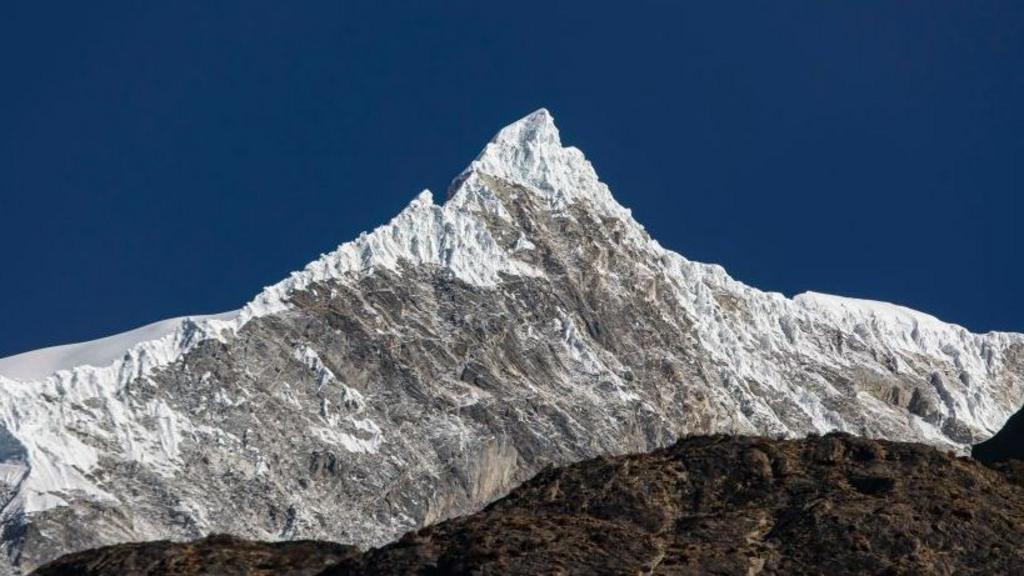
Nepal’s flash floods expose a new high-mountain hazard
Day’s Recap
“
”
Supporting Articles
Rising temperatures are accelerating glacier and permafrost melt in the Himalayas, increasing the risk of floods, landslides, and related disasters, although scientists have not yet determined how much climate change contributed to this week's landslide.
11:22 PMThe New York Times
A mountain collapse in Nepal generated a flash flood so sudden and powerful that survivors had little time to respond. At least hundreds of people died, while many others remained missing.
6:45 PMThe New York Times
Scientists believe a collapse involving a glacier and surrounding rock near the Nepal-China border triggered a massive flood. The event sent water rapidly downstream and caused catastrophic damage in Nepal.
3:43 PMAl Jazeera
Researchers used AI to search more than 100 million 3D-printing configurations for the NASA alloy GRCop-42. After 40 experiments, it identified six workable settings, including one that printed the alloy at a record-low 500 watts.
9:08 AMScienceDaily
Astronomers have obtained the clearest image yet of a long-suspected companion star orbiting Betelgeuse. The companion appears unexpectedly massive and could help explain Betelgeuse’s changing brightness and influence its eventual supernova.
8:43 AMScienceDaily
Researchers induced electronic patterns consistent with altermagnetism in ultrathin ruthenium dioxide by applying strain to films only a few atomic layers thick. The material normally appears nonmagnetic, but its altered state could have applications in advanced electronics.
5:23 AMScienceDaily
11:22 PMThe New York Times
Climate Change Raises Risk of Disasters Like Nepal Floods
Summary
Rising temperatures are accelerating glacier and permafrost melt in the Himalayas, increasing the risk of floods, landslides, and related disasters, although scientists have not yet determined how much climate change contributed to this week's landslide.
The established shift is a more hazardous Himalayan environment as warming weakens ice, frozen ground,
Unlock the full First Pass Analysis to get a better understanding of why this story matters
Why it matters
Uncertain attribution for one disaster does not diminish the clear increase in long-term regional hazard.
In Nepal, a Catastrophe So Sudden There Was No Time to React
Summary
A mountain collapse in Nepal generated a flash flood so sudden and powerful that survivors had little time to respond. At least hundreds of people died, while many others remained missing.
The defining fact is the gap between the collapse and the flood’s arrival: communities had
Unlock the full First Pass Analysis to get a better understanding of why this story matters
Why it matters
Disaster plans built around gradual flooding may fail when mountain collapses produce near-instant inundation.
How a glacial collapse caused Nepal’s catastrophic floods
Summary
Scientists believe a collapse involving a glacier and surrounding rock near the Nepal-China border triggered a massive flood. The event sent water rapidly downstream and caused catastrophic damage in Nepal.
The likely trigger was a compound mountain hazard, with ice and rock failure displacing water
Unlock the full First Pass Analysis to get a better understanding of why this story matters
Why it matters
Rapid glacier-related collapses create a growing disaster risk in high-mountain regions with limited warning systems.
Rock Landslide and Glacial Collapse Likely Caused Floods in Nepal and Tibet, Scientists Say
Summary
New satellite imagery indicates that a rock landslide and the collapse of a glacier likely triggered the deadly floods in Nepal and Tibet. The images give scientists a clearer reconstruction of the chain of events behind the disaster.
The evidence shifts the explanation from a broad flood event to a linked sequence of
Unlock the full First Pass Analysis to get a better understanding of why this story matters
Why it matters
Identifying the trigger chain can improve early-warning systems for communities exposed to unstable mountain slopes and glaciers.
At least 270 people have died in the massive flash floods, and more than 800 remain missing. The report examines the causes of the disaster as authorities continue assessing its human toll.
The death toll and number missing show that the floods became a major regional disaster,
Unlock the full First Pass Analysis to get a better understanding of why this story matters
Why it matters
The cause will determine how governments prepare communities for increasingly dangerous flood events in the Himalayas.
Nepal-Tibet floods: What is a glacial collapse, how common is it?
Summary
More than 165 people have died in floods triggered by a massive glacial collapse near the Nepal-China border. The event has raised questions about how glacier failures generate sudden floods and how often such disasters occur.
The collapse turned a high-altitude ice failure into a fast-moving flood that overwhelmed communities downstream.
Unlock the full First Pass Analysis to get a better understanding of why this story matters
Why it matters
Glacier surveillance and downstream warning systems are becoming essential disaster infrastructure across the Himalayas.
Collapsed glacier likely caused devastating Nepal-Tibet floods, scientists say
Summary
Preliminary scientific investigations indicate that a collapsed glacier caused the devastating floods in the Nepal-Tibet region. The event has renewed concern about the effects of rapidly melting Himalayan ice.
Scientists have identified a likely physical trigger, but the finding remains preliminary while investigators establish
Unlock the full First Pass Analysis to get a better understanding of why this story matters
Why it matters
Confirming the cause would strengthen the case for treating Himalayan glacier loss as an immediate flood-risk issue.
AI searched 100 million possibilities and found a cheaper way to 3D-print a NASA rocket alloy
Summary
Researchers used AI to search more than 100 million 3D-printing configurations for the NASA alloy GRCop-42. After 40 experiments, it identified six workable settings, including one that printed the alloy at a record-low 500 watts.
The key shift is from testing printing parameters one by one to using AI to
Unlock the full First Pass Analysis to get a better understanding of why this story matters
Why it matters
Cheaper, more accessible printing could expand production of rocket components and shorten materials-development cycles.
“I jumped from my chair” – Astronomers spot Betelgeuse’s hidden companion
Summary
Astronomers have obtained the clearest image yet of a long-suspected companion star orbiting Betelgeuse. The companion appears unexpectedly massive and could help explain Betelgeuse’s changing brightness and influence its eventual supernova.
The companion gives astronomers a new variable for interpreting Betelgeuse’s behavior, which had largely been
Unlock the full First Pass Analysis to get a better understanding of why this story matters
Why it matters
A second star may reshape the leading explanations for Betelgeuse’s variability and future evolution.
Scientists switch on a strange new form of magnetism in an ultrathin material
Summary
Researchers induced electronic patterns consistent with altermagnetism in ultrathin ruthenium dioxide by applying strain to films only a few atomic layers thick. The material normally appears nonmagnetic, but its altered state could have applications in advanced electronics.
The result shows that reducing a material to atomic-scale thickness and mechanically straining it can
Unlock the full First Pass Analysis to get a better understanding of why this story matters
Why it matters
Controllable altermagnetism could expand the materials available for faster and more energy-efficient spin-based electronics.
A curated list of other prominent stories from this day.
Marc Tessier-Lavigne has released emails and other details about his research and travel to challenge allegations that he published fraudulent results and helped conceal misconduct.
1:27 PMStat News
Evidence from ancient teeth and human DNA suggests insect eating varied sharply across human populations and may have declined early in northern Eurasia. Neanderthals appear to have eaten insects more regularly, while some tropical populations retained genetic adaptations for digesting insect exoskeletons.
8:18 AMScienceDaily
A proposed population of ancient Dark Stars could account for part of the gravitational-wave background detected across the Universe. If the idea holds, the signal would preserve information about how the first supermassive black holes formed and how dark matter behaved during cosmic dawn.
6:26 AMScienceDaily
A personalized cancer vaccine developed by Moderna and Merck may owe part of its promise to an algorithm that selects the tumor mutations most likely to trigger an immune response. The technology combines computational prediction with immunology and cancer biology.
4:30 AMStat News
A 324-million-year-old fossil shows an early insect relative with paddle-like abdominal limbs suited to aquatic movement. It supports the idea that insects transitioned gradually through an amphibious phase rather than moving abruptly from water to land.
3:22 AMScienceDaily
1:27 PMStat News
STAT+: Former Stanford president releases emails to rebut fraud and cover-up allegations in new book
Summary
Marc Tessier-Lavigne has released emails and other details about his research and travel to challenge allegations that he published fraudulent results and helped conceal misconduct.
The dispute has moved from the findings of prior investigations to a public contest over
Unlock the full First Pass Analysis to get a better understanding of why this story matters
Why it matters
The case tests whether transparency after a scientific leadership scandal can restore trust or merely deepen the evidentiary dispute.
Your dislike of eating bugs may be 9,000 years old
Summary
Evidence from ancient teeth and human DNA suggests insect eating varied sharply across human populations and may have declined early in northern Eurasia. Neanderthals appear to have eaten insects more regularly, while some tropical populations retained genetic adaptations for digesting insect exoskeletons.
Modern insect aversion may reflect deep regional dietary history rather than a universal human preference.
Unlock the full First Pass Analysis to get a better understanding of why this story matters
Why it matters
The findings show that expanding insect-based diets will require more than making the food available.
A mysterious cosmic hum may come from 13-billion-year-old dark stars
Summary
A proposed population of ancient Dark Stars could account for part of the gravitational-wave background detected across the Universe. If the idea holds, the signal would preserve information about how the first supermassive black holes formed and how dark matter behaved during cosmic dawn.
The hypothesis connects an unresolved gravitational-wave signal to a speculative class of stars powered partly
Unlock the full First Pass Analysis to get a better understanding of why this story matters
Why it matters
A cosmic background signal could become a probe of both dark matter and the Universe’s first black-hole seeds.
A personalized cancer vaccine developed by Moderna and Merck may owe part of its promise to an algorithm that selects the tumor mutations most likely to trigger an immune response. The technology combines computational prediction with immunology and cancer biology.
The decisive shift is toward algorithms as a central part of cancer vaccine design, rather
Unlock the full First Pass Analysis to get a better understanding of why this story matters
Why it matters
The algorithm may determine whether personalized cancer vaccines remain a niche treatment or become a broader platform.
324-million-year-old fossil reveals how insects conquered land
Summary
A 324-million-year-old fossil shows an early insect relative with paddle-like abdominal limbs suited to aquatic movement. It supports the idea that insects transitioned gradually through an amphibious phase rather than moving abruptly from water to land.
The fossil fills a critical gap between aquatic arthropod ancestors and fully terrestrial insects. It
Unlock the full First Pass Analysis to get a better understanding of why this story matters
Why it matters
The discovery identifies a plausible intermediate stage in one of the most consequential transitions in animal evolution.