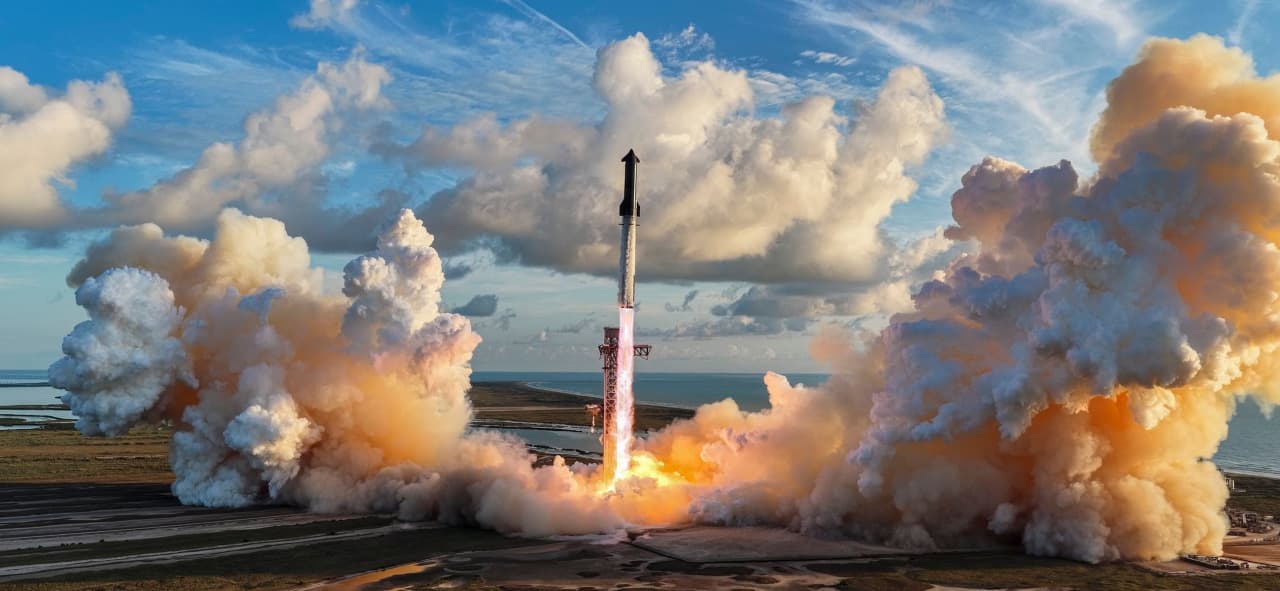
A recent Starship launch advances several priorities that could strengthen SpaceX's long-term business prospects, according to a bullish analyst view that puts the company's potential stock price near $900.
5:53 PMMarketWatch8 stories from 6 sources
Supporting Articles
A recent Starship launch advances several priorities that could strengthen SpaceX's long-term business prospects, according to a bullish analyst view that puts the company's potential stock price near $900.
5:53 PMMarketWatch
SpaceX’s Starship reached orbit for the first time, marking a major milestone for the rocket program. The mission ended early after an engine failure.
2:32 AMBloomberg Markets
Enceladus may concentrate chemicals from its underground ocean as droplets freeze and fracture while being ejected into space. That process could explain the unusual chemistry of ice grains detected by the Cassini mission and improve the search for organic compounds.
5:58 AMScienceDaily
A drone strike damaged Ukraine's National Academy of Sciences, an institution credited with more than 90 percent of the country's scientific discoveries, including work in astronomy and military technology.
3:55 PMThe New York TimesSummary
A recent Starship launch advances several priorities that could strengthen SpaceX's long-term business prospects, according to a bullish analyst view that puts the company's potential stock price near $900.
The launch matters financially only if SpaceX converts technical progress into reliable, repeatable missions and
Unlock the full First Pass Analysis to get a better understanding of why this story mattersWhy it matters
Starship's progress is becoming central to the investment case for SpaceX, even as its most ambitious valuation claims remain highly speculative.
Summary
SpaceX’s Starship reached orbit for the first time, marking a major milestone for the rocket program. The mission ended early after an engine failure.
Reaching orbit moves Starship from developmental testing toward operational credibility, even though the engine failure
Unlock the full First Pass Analysis to get a better understanding of why this story mattersWhy it matters
Starship’s first orbital success brings SpaceX closer to a reusable heavy-lift system, but the engine failure shows the program is not yet operationally mature.
Summary
Enceladus may concentrate chemicals from its underground ocean as droplets freeze and fracture while being ejected into space. That process could explain the unusual chemistry of ice grains detected by the Cassini mission and improve the search for organic compounds.
The finding changes how scientists may interpret material sampled from Enceladus's plumes. Chemical enrichment during
Unlock the full First Pass Analysis to get a better understanding of why this story mattersWhy it matters
A natural sampling mechanism could make Enceladus one of the most accessible places to investigate whether life exists beyond Earth.
Summary
A drone strike damaged Ukraine's National Academy of Sciences, an institution credited with more than 90 percent of the country's scientific discoveries, including work in astronomy and military technology.
The damage threatens more than a historic building because the academy supports research with civilian
Unlock the full First Pass Analysis to get a better understanding of why this story mattersWhy it matters
Russia's war is damaging the research infrastructure Ukraine needs for defense, reconstruction, and long-term technological independence.
A curated list of other prominent stories from this day.
Archaeologists say a Roman settlement at Stein, Austria, may be Claudivium, a site recorded by the second-century geographer Ptolemy. The proposed identification rests on the close match between Ptolemy's coordinates and the settlement's location.
4:09 PMARTnews
Researchers found in mice that preventing certain T cells from entering the brain slowed neurodegeneration. The findings suggest that immune-cell trafficking may contribute to disease progression, though the approach has not yet been shown to work in humans.
8:02 AMStat News
Scientists may have linked small, decade-scale changes in the length of Earth’s day to movements in the inner core. Interactions between the core and mantle could alter the planet’s rotation by milliseconds.
1:08 AMScienceDaily
NASA and SpaceX plan to launch four astronauts to the International Space Station, with the Dragon spacecraft potentially docking in less than nine hours. The mission will join Expedition 75 after final launch-readiness checks.
12:38 AMScienceDailySummary
Archaeologists say a Roman settlement at Stein, Austria, may be Claudivium, a site recorded by the second-century geographer Ptolemy. The proposed identification rests on the close match between Ptolemy's coordinates and the settlement's location.
The coordinate match gives Stein a credible claim to the long-unlocated settlement, but it does
Unlock the full First Pass Analysis to get a better understanding of why this story mattersWhy it matters
Confirming Claudivium would sharpen understanding of Roman settlement and administration in the region.
Summary
Researchers found in mice that preventing certain T cells from entering the brain slowed neurodegeneration. The findings suggest that immune-cell trafficking may contribute to disease progression, though the approach has not yet been shown to work in humans.
The decisive finding is that restricting immune access to the brain altered the course of
Unlock the full First Pass Analysis to get a better understanding of why this story mattersWhy it matters
The study strengthens the case for targeting immune activity in neurodegeneration while underscoring how far animal evidence remains from a therapy.
Summary
Scientists may have linked small, decade-scale changes in the length of Earth’s day to movements in the inner core. Interactions between the core and mantle could alter the planet’s rotation by milliseconds.
The result assigns a larger role to deep-Earth dynamics in explaining changes once treated mainly
Unlock the full First Pass Analysis to get a better understanding of why this story mattersWhy it matters
Tiny changes in day length provide a rare measurement of processes occurring thousands of kilometres beneath the surface.
Summary
NASA and SpaceX plan to launch four astronauts to the International Space Station, with the Dragon spacecraft potentially docking in less than nine hours. The mission will join Expedition 75 after final launch-readiness checks.
The short transit reflects the operational maturity of commercial crew flights and the ISS's continuing
Unlock the full First Pass Analysis to get a better understanding of why this story mattersWhy it matters
Fast, repeatable crew transport is essential to keeping the ISS staffed and making commercial access to low Earth orbit routine.
Make it yours
Pick your topics, set your cadence, and receive your personalized First Pass in your inbox. It’s that simple!