
The US added 29,000 jobs in September, far below expectations, while the unemployment rate rose to 4.2%. The weak report led traders to reduce bets on further Federal Reserve rate increases.
4:05 PMFinancial Times87 stories from 9 sources
Supporting Articles
The US added 29,000 jobs in September, far below expectations, while the unemployment rate rose to 4.2%. The weak report led traders to reduce bets on further Federal Reserve rate increases.
4:05 PMFinancial Times
Nonfarm payrolls, employment across major industries and the unemployment rate changed little in September, according to the latest labor report. The data point to a low hire, low fire labor market rather than a sharp deterioration.
2:44 PMPYMNTS
US payroll growth stalled at 29,000 in September, unemployment rose to 4.2%, and prior two-month job gains were revised down by 60,000. The weaker labor report could ease pressure on mortgage rates by reducing expectations for further Fed tightening.
10:42 AMHousing Wire
A weak U.S. jobs report briefly revived demand for Treasurys as a haven. The rally faded quickly, showing that softer labor data alone was not enough to sustain lower yields.
4:12 PMMarketWatch
The 10-year US Treasury yield rose even after September employment data came in well below expectations.
4:03 PMCNBC
Eurozone consumer prices rose 3.8% in September, reaching a three-year high and exceeding expectations.
11:45 AMFinancial Times
U.S. stocks rose after payroll growth came in at 29,000, well below the 90,000 economists had expected. Real estate stocks and small caps gained about 1% as investors reduced expectations for another Federal Reserve rate increase, although the Dow and S&P 500 still posted weekly declines.
4:15 PMEconomic TimesStocks remain vulnerable to elevated Treasury yields and oil prices, although this week's brief relief in both markets showed how quickly equities can respond when those pressures ease.
4:09 PMCNBC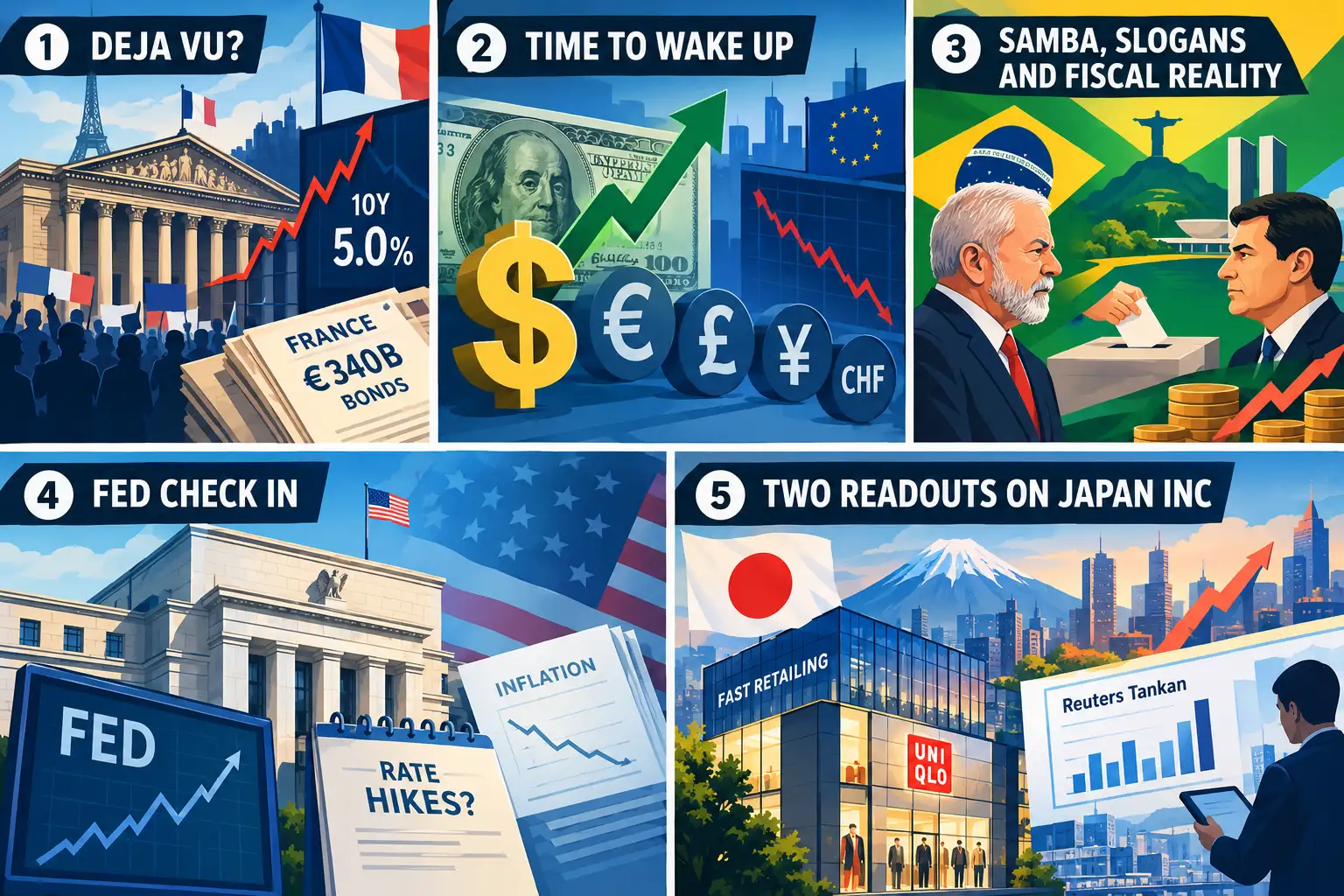
Global markets are confronting higher borrowing costs as France’s budget politics add pressure to European assets. The euro is fluctuating against the dollar, while Brazil’s coming elections could amplify market volatility amid elevated rates and economic concerns.
11:57 PMEconomic Times
German government bonds have rallied this week, pushing Bund yields lower even as US, French and other sovereign debt markets have sold off. The divergence reflects demand for Germany's relative safety amid renewed inflation concerns.
9:03 AMFinancial Times
US stocks enter a seasonally strong fourth quarter with rising bond yields, the November elections, and the upcoming earnings season creating competing pressures. Expected profit growth depends heavily on continued spending on AI infrastructure, increasing the market’s sensitivity to corporate results and technology investment plans.
11:52 PMEconomic Times
Strong earnings linked to AI investment have continued to support US equities despite rising bond yields and geopolitical tensions. Investors are increasingly questioning whether the AI capital-spending cycle can deliver sufficient returns as G7 government bonds enter a structural bear market.
10:26 PMEconomic Times
The S&P 500 remains near a record even though most individual stocks are struggling. The gap points to unusually narrow market leadership and a concentration of gains in a small group of large companies.
7:48 AMMarketWatch
Homeowners with low-rate mortgages are staying put, freezing housing supply while affordability remains as strained as it was during the housing bubble.
7:09 AMFinancial TimesThe IMF approved a $1.9 billion financing program for Bolivia, with $214 million available immediately. The package aims to help President Rodrigo Paz address the country’s sharp economic downturn and advance his reform agenda.
8:55 PMBloomberg MarketsSummary
The US added 29,000 jobs in September, far below expectations, while the unemployment rate rose to 4.2%. The weak report led traders to reduce bets on further Federal Reserve rate increases.
The labor market is weakening quickly enough to challenge the Fed's willingness to keep tightening
Unlock the full First Pass Analysis to get a better understanding of why this story mattersWhy it matters
A sharp loss of hiring momentum could move markets from pricing persistent inflation toward pricing an economic slowdown.
3 stories · 3 sources
Summary
Nonfarm payrolls, employment across major industries and the unemployment rate changed little in September, according to the latest labor report. The data point to a low hire, low fire labor market rather than a sharp deterioration.
Hiring has slowed, but employers are not broadly cutting jobs, leaving the labor market stable
Unlock the full First Pass Analysis to get a better understanding of why this story mattersWhy it matters
A stable but weakening labor market gives policymakers room to wait, while reducing the economy's growth cushion.
Summary
US payroll growth stalled at 29,000 in September, unemployment rose to 4.2%, and prior two-month job gains were revised down by 60,000. The weaker labor report could ease pressure on mortgage rates by reducing expectations for further Fed tightening.
The downward revisions make the slowdown broader than a single weak monthly figure. Mortgage rates
Unlock the full First Pass Analysis to get a better understanding of why this story mattersWhy it matters
A cooler labor market could improve housing affordability through lower borrowing costs, even if it signals weaker economic conditions.
Summary
A weak U.S. jobs report briefly revived demand for Treasurys as a haven. The rally faded quickly, showing that softer labor data alone was not enough to sustain lower yields.
The initial bond rally reflected reduced expectations for further rate increases, but investors soon refocused
Unlock the full First Pass Analysis to get a better understanding of why this story mattersWhy it matters
Treasury yields are no longer responding mechanically to weaker economic data, making inflation and government borrowing more important market drivers.
Summary
The 10-year US Treasury yield rose even after September employment data came in well below expectations.
The move shows that rate expectations were not the only force driving Treasuries, with investors
Unlock the full First Pass Analysis to get a better understanding of why this story mattersWhy it matters
The market response warns that weaker growth alone may not deliver lasting relief in long term borrowing costs.
2 stories · 2 sources
Summary
Eurozone consumer prices rose 3.8% in September, reaching a three-year high and exceeding expectations.
The upside inflation surprise reduces the European Central Bank's room to cut rates quickly, even
Unlock the full First Pass Analysis to get a better understanding of why this story mattersWhy it matters
Markets may need to price a slower easing cycle, raising borrowing costs across the eurozone.
Summary
U.S. stocks rose after payroll growth came in at 29,000, well below the 90,000 economists had expected. Real estate stocks and small caps gained about 1% as investors reduced expectations for another Federal Reserve rate increase, although the Dow and S&P 500 still posted weekly declines.
The weak jobs report shifted markets toward lower-rate expectations, lifting sectors most sensitive to borrowing
Unlock the full First Pass Analysis to get a better understanding of why this story mattersWhy it matters
Markets are now balancing the benefit of easier policy against the risk that weak hiring signals a deeper slowdown.
Summary
Stocks remain vulnerable to elevated Treasury yields and oil prices, although this week's brief relief in both markets showed how quickly equities can respond when those pressures ease.
The market's immediate direction depends on whether yields and oil stabilize, not simply on earnings
Unlock the full First Pass Analysis to get a better understanding of why this story mattersWhy it matters
Equities face simultaneous pressure from tighter financial conditions and higher operating costs.
Summary
Global markets are confronting higher borrowing costs as France’s budget politics add pressure to European assets. The euro is fluctuating against the dollar, while Brazil’s coming elections could amplify market volatility amid elevated rates and economic concerns.
Higher financing costs are tightening conditions across major markets, leaving politically exposed economies such as
Unlock the full First Pass Analysis to get a better understanding of why this story mattersWhy it matters
Rising borrowing costs are making fiscal and election risks more likely to spill into currencies, bonds, and broader global markets.
Summary
German government bonds have rallied this week, pushing Bund yields lower even as US, French and other sovereign debt markets have sold off. The divergence reflects demand for Germany's relative safety amid renewed inflation concerns.
Capital is moving toward Bunds because investors see them as a safer store of value
Unlock the full First Pass Analysis to get a better understanding of why this story mattersWhy it matters
The split in sovereign bond performance signals growing concern about fiscal credibility and inflation risk across major markets.
Summary
US stocks enter a seasonally strong fourth quarter with rising bond yields, the November elections, and the upcoming earnings season creating competing pressures. Expected profit growth depends heavily on continued spending on AI infrastructure, increasing the market’s sensitivity to corporate results and technology investment plans.
Spiking bond yields are the immediate threat to the market’s typical fourth-quarter strength because they
Unlock the full First Pass Analysis to get a better understanding of why this story mattersWhy it matters
US equities face a narrower margin for error as higher yields and political risk test whether AI-led earnings can sustain valuations.
Summary
Strong earnings linked to AI investment have continued to support US equities despite rising bond yields and geopolitical tensions. Investors are increasingly questioning whether the AI capital-spending cycle can deliver sufficient returns as G7 government bonds enter a structural bear market.
The key shift is from an equity-led earnings narrative to a broader rates risk: higher
Unlock the full First Pass Analysis to get a better understanding of why this story mattersWhy it matters
US equities face a tougher regime in which resilient AI earnings may no longer offset persistent bond-market pressure.
Summary
The S&P 500 remains near a record even though most individual stocks are struggling. The gap points to unusually narrow market leadership and a concentration of gains in a small group of large companies.
The market's headline strength is masking weaker breadth, making the index more dependent on a
Unlock the full First Pass Analysis to get a better understanding of why this story mattersWhy it matters
A near record index is less reassuring when fewer stocks are carrying the market.
Summary
Homeowners with low-rate mortgages are staying put, freezing housing supply while affordability remains as strained as it was during the housing bubble.
The mortgage lock-in effect is keeping existing owners from selling, which limits supply and prevents
Unlock the full First Pass Analysis to get a better understanding of why this story mattersWhy it matters
Housing can remain unaffordable and economically rigid even if the Fed begins cutting rates.
Summary
The IMF approved a $1.9 billion financing program for Bolivia, with $214 million available immediately. The package aims to help President Rodrigo Paz address the country’s sharp economic downturn and advance his reform agenda.
The immediate disbursement gives Paz near-term financing to stabilize the economy, but the broader program
Unlock the full First Pass Analysis to get a better understanding of why this story mattersWhy it matters
The deal gives Bolivia a financial lifeline while tying economic stabilization to the pace and credibility of Paz’s reforms.
A curated list of other prominent stories from this day.

Investor interest has weakened in large-cap stocks even as valuations improve, while retail investors remain enthusiastic about mid- and small-cap shares. Recent gains and expectations of faster returns are sustaining that appetite despite broader market and geopolitical concerns.
10:18 PMEconomic TimesFormer CEA Chair Cecilia Rouse says monthly job gains may be settling into a lower baseline, with break-even employment growth potentially near 50,000. She also discusses the implications for economic growth.
6:17 PMBloomberg Markets
The article compares falling wages, rising energy costs, and persistent inflation with the economic conditions of the 1970s. It asks whether investors should revisit the strategies used during that period.
8:00 PMMarketWatchEmerging-market currencies rose after September payrolls increased by just 29,000, far below economists' expectations, while previous months were revised lower. The weak report reduced expectations for another Federal Reserve rate hike this month.
5:42 PMBloomberg MarketsCEA Chairman Chris Phelan says inflation is clearly easing and believes the decline is occurring quickly enough. His assessment supports the view that price pressures are moving toward a more manageable path.
5:40 PMBloomberg MarketsFormer Labor Secretary Robert Reich describes an economy with persistent inflation, very slow hiring, and wages that are not keeping pace with prices. His comments frame the jobs report as a sign of pressure on workers despite continued price gains.
5:32 PMBloomberg Markets
Data suggests partisan exchange-traded funds can leave investors with higher fees and lower returns than broad-market alternatives.
4:43 PMMarketWatchUBS identifies the 10-year Treasury yield level at which bond income may no longer offset the capital losses caused by rising prices. The analysis focuses on when income-oriented investors should reassess their exposure.
4:10 PMCNBCUtilities have become a battleground as the bond sell-off pressures one of the market's strongest sectors. Mike Khouw argues the sector may be positioned for a rebound.
11:34 AMCNBC
Trend-following hedge funds have profited from the sharp rise in global bond yields this year. Their positions responded to inflation concerns fueled by the Iran war and stronger-than-expected U.S. economic data.
11:13 AMFinancial Times
Scott Rubner of Citadel Securities argues that September reset the stock market and created conditions for a stronger finish to the year.
9:30 AMMarketWatch
BlackRock CEO Larry Fink said America has lost the stability represented by his father’s single-career working life. He also pointed to a widening divide between wage earners and people whose wealth grows through investments.
2:56 AMFortuneSummary
Investor interest has weakened in large-cap stocks even as valuations improve, while retail investors remain enthusiastic about mid- and small-cap shares. Recent gains and expectations of faster returns are sustaining that appetite despite broader market and geopolitical concerns.
The market is showing a widening gap between institutional caution toward large caps and retail
Unlock the full First Pass Analysis to get a better understanding of why this story mattersWhy it matters
Investor behavior is becoming more speculative, increasing the market’s vulnerability to a correction concentrated in smaller stocks.
Summary
Former CEA Chair Cecilia Rouse says monthly job gains may be settling into a lower baseline, with break-even employment growth potentially near 50,000. She also discusses the implications for economic growth.
A structurally weaker hiring pace would mark a shift from post-pandemic labor strength, even if
Unlock the full First Pass Analysis to get a better understanding of why this story mattersWhy it matters
A lower employment baseline would change how markets interpret even modest payroll gains and losses.
Summary
The article compares falling wages, rising energy costs, and persistent inflation with the economic conditions of the 1970s. It asks whether investors should revisit the strategies used during that period.
The comparison matters if supply shocks are again keeping prices high while real incomes weaken,
Unlock the full First Pass Analysis to get a better understanding of why this story mattersWhy it matters
A stagflationary mix would challenge both growth-focused portfolios and the assumption that weaker demand will quickly bring inflation down.
Summary
Emerging-market currencies rose after September payrolls increased by just 29,000, far below economists' expectations, while previous months were revised lower. The weak report reduced expectations for another Federal Reserve rate hike this month.
The jobs miss shifted the immediate policy risk from tighter US rates toward a possible
Unlock the full First Pass Analysis to get a better understanding of why this story mattersWhy it matters
US labor data is again driving the dollar, Treasury yields, and the funding conditions facing emerging markets.
Summary
CEA Chairman Chris Phelan says inflation is clearly easing and believes the decline is occurring quickly enough. His assessment supports the view that price pressures are moving toward a more manageable path.
If disinflation continues without a major rise in unemployment, the Federal Reserve could gain room
Unlock the full First Pass Analysis to get a better understanding of why this story mattersWhy it matters
The pace of disinflation will determine whether weaker growth leads to easier policy or merely a pause in tightening.
Summary
Former Labor Secretary Robert Reich describes an economy with persistent inflation, very slow hiring, and wages that are not keeping pace with prices. His comments frame the jobs report as a sign of pressure on workers despite continued price gains.
The combination of weak hiring and falling real wages creates a difficult policy mix: households
Unlock the full First Pass Analysis to get a better understanding of why this story mattersWhy it matters
Stagnant real incomes can weaken consumption before inflation has fallen far enough to support easier policy.
Summary
Data suggests partisan exchange-traded funds can leave investors with higher fees and lower returns than broad-market alternatives.
Political alignment can push investors toward concentrated products that charge more and provide less diversification.
Unlock the full First Pass Analysis to get a better understanding of why this story mattersWhy it matters
Investors may be paying for ideological exposure that weakens long-term returns.
Summary
UBS identifies the 10-year Treasury yield level at which bond income may no longer offset the capital losses caused by rising prices. The analysis focuses on when income-oriented investors should reassess their exposure.
The risk is not simply a higher yield, but a sustained rise that overwhelms coupon
Unlock the full First Pass Analysis to get a better understanding of why this story mattersWhy it matters
Investors need to weigh the income from Treasuries against the duration risk created by further rate increases.
Summary
Utilities have become a battleground as the bond sell-off pressures one of the market's strongest sectors. Mike Khouw argues the sector may be positioned for a rebound.
The bond sell-off has challenged utilities because higher yields make their income streams less attractive
Unlock the full First Pass Analysis to get a better understanding of why this story mattersWhy it matters
Utilities now offer a direct test of whether markets are ready to reverse the rate-driven rotation out of defensive, income-focused stocks.
Summary
Trend-following hedge funds have profited from the sharp rise in global bond yields this year. Their positions responded to inflation concerns fueled by the Iran war and stronger-than-expected U.S. economic data.
The bond sell-off has rewarded systematic strategies that follow persistent market trends rather than anticipate
Unlock the full First Pass Analysis to get a better understanding of why this story mattersWhy it matters
A widening gap between bond winners and losers shows how quickly macro shocks are reshaping hedge-fund returns.
Summary
Scott Rubner of Citadel Securities argues that September reset the stock market and created conditions for a stronger finish to the year.
The bullish case rests on a market that has absorbed recent selling without breaking its
Unlock the full First Pass Analysis to get a better understanding of why this story mattersWhy it matters
A post-reset rally would reward investors who treat the recent pullback as a repositioning event rather than a trend change.
Summary
BlackRock CEO Larry Fink said America has lost the stability represented by his father’s single-career working life. He also pointed to a widening divide between wage earners and people whose wealth grows through investments.
The core issue is the declining ability of ordinary workers to build durable economic security
Unlock the full First Pass Analysis to get a better understanding of why this story mattersWhy it matters
The divide between labor income and investment wealth is becoming a central risk to social stability and economic legitimacy.
Make it yours
Pick your topics, set your cadence, and receive your personalized First Pass in your inbox. It’s that simple!

