Crypto market-structure bill dominates fintech’s next regulatory test
Day’s Recap
“
”
Supporting Articles
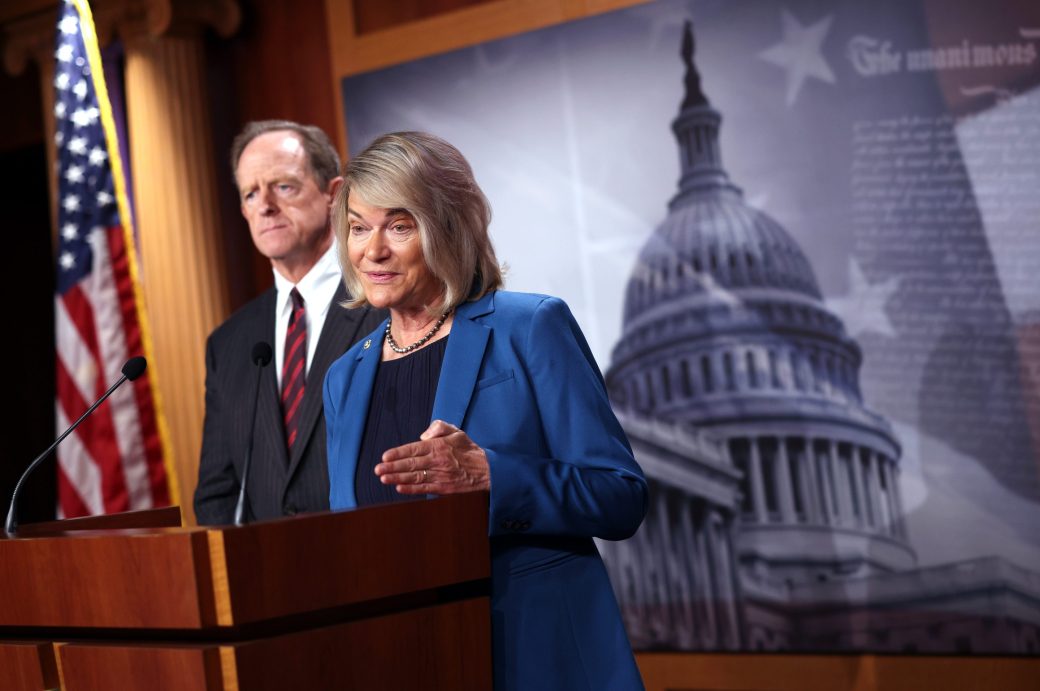
The Senate is scheduled to vote Tuesday on the Clarity Act, a major crypto market-structure bill, after Majority Leader John Thune set the measure for consideration. The vote will test whether industry lobbying has secured enough support to advance the legislation.
4:54 PMCNBC
The Senate is preparing to vote on the Clarity Act, a bill initially designed to define how digital assets are classified and regulated. Successive revisions have expanded its scope into broader questions about market structure and the relationship between crypto firms and traditional financial institutions.
4:52 PMPYMNTS
Sens. Cynthia Lummis, John Boozman, and Tim Scott released a final draft of the Clarity Act with expanded ethics provisions and measures intended to prevent deposit flight linked to payment stablecoins. The draft was issued one day before a critical Senate vote.
1:14 PMPYMNTS
Nearly 1,000 US merchants have urged a federal judge to reject a proposed settlement in the lawsuit over Visa and Mastercard credit card interchange fees. They argue that the agreement offers inadequate relief and contains loopholes that would weaken its effect.
8:01 PMFinextra
Payments companies are using Georgia's limited purpose bank charter to build more direct access to US payment infrastructure. The model could reduce their reliance on traditional sponsor banks for acquiring and related services.
6:08 PMPYMNTS
An AI agent has passed a demanding European payment authentication test, demonstrating that automated systems can complete a high-security payment verification process. The result suggests that AI agents are moving closer to handling authenticated financial transactions.
11:27 AMFinextra
A Washington University study found that about 30% of Americans are using buy now, pay later loans to purchase groceries. The research indicates that broader use of consumer financing raises retailers' costs, which can contribute to higher prices for all shoppers.
1:54 PMFortune
Nubank has entered the US market with a deposit account and other products delivered through a partnership with a sponsor bank.
8:01 PMFinextra
Revolut disclosed sensitive customer information, including passport details, after employees acted on fraudulent requests sent from an authentic government agency email domain. The incident shows how attackers used trusted institutional channels to bypass normal scrutiny.
10:02 AMFinextra
The article argues that banks must govern the authority granted to AI systems that can initiate or direct payments, rather than treating the issue solely as a conventional model-risk problem. It focuses on the controls needed when software can act on financial accounts.
11:52 AMFinextra
4:54 PMCNBC
Trump agrees to ethics requirements in crypto Clarity Act as GOP seeks Democratic votes
Summary
The Senate is scheduled to vote Tuesday on the Clarity Act, a major crypto market-structure bill, after Majority Leader John Thune set the measure for consideration. The vote will test whether industry lobbying has secured enough support to advance the legislation.
The decisive shift is from lobbying to a recorded Senate test. Approval would move the
Unlock the full First Pass Analysis to get a better understanding of why this story matters
Why it matters
The vote could determine whether crypto gets a statutory market-structure regime or remains governed by regulatory ambiguity.
US Senate Republicans release new crypto bill text ahead of critical vote
Summary
Senate Republicans released a revised Clarity Act containing 126 substantive changes sought by Democrats ahead of a key procedural vote. Passage remains uncertain because Democrats are evaluating ethics safeguards and banks oppose provisions that would allow stablecoin rewards.
The revised text shows Republicans are trying to convert the bill from a partisan proposal
Unlock the full First Pass Analysis to get a better understanding of why this story matters
Why it matters
The vote will test whether negotiated changes can overcome both Democratic ethics concerns and banking industry opposition.
Clarity Act odds soar as Trump approves new ethics provisions for closely watched crypto bill
Summary
Republicans have accepted new ethics provisions for the delayed Clarity Act after approval from President Trump. The concession could help clear a major obstacle to advancing the crypto market-structure bill.
The decisive shift is Republican movement on ethics safeguards, which addresses a central Democratic objection
Unlock the full First Pass Analysis to get a better understanding of why this story matters
Why it matters
The bill is moving closer to establishing the regulatory rules that crypto companies and financial institutions have sought.
Crypto’s Search for Clarity Runs Into the Real Economy
Summary
The Senate is preparing to vote on the Clarity Act, a bill initially designed to define how digital assets are classified and regulated. Successive revisions have expanded its scope into broader questions about market structure and the relationship between crypto firms and traditional financial institutions.
The bill has shifted from a narrow classification measure into a framework that could redraw
Unlock the full First Pass Analysis to get a better understanding of why this story matters
Why it matters
The legislation could determine which institutions control trading, custody and payments as crypto becomes more integrated with mainstream finance.
Sens. Cynthia Lummis, John Boozman, and Tim Scott released a final draft of the Clarity Act with expanded ethics provisions and measures intended to prevent deposit flight linked to payment stablecoins. The draft was issued one day before a critical Senate vote.
The added language targets two political vulnerabilities: conflicts of interest around digital assets and the
Unlock the full First Pass Analysis to get a better understanding of why this story matters
Why it matters
The bill's outcome could determine how stablecoin issuers compete with banks and how lawmakers police conflicts in crypto legislation.
Merchants call on judge to reject Visa-Mastercard interchange fee settlement
Summary
Nearly 1,000 US merchants have urged a federal judge to reject a proposed settlement in the lawsuit over Visa and Mastercard credit card interchange fees. They argue that the agreement offers inadequate relief and contains loopholes that would weaken its effect.
Merchant opposition keeps the settlement from resolving the central dispute over card pricing and network
Unlock the full First Pass Analysis to get a better understanding of why this story matters
Why it matters
The court's decision could determine whether merchants receive meaningful relief or whether the existing card-fee structure survives largely intact.
Payments Firms Put Georgia’s Limited Purpose Bank Charter to Work
Summary
Payments companies are using Georgia's limited purpose bank charter to build more direct access to US payment infrastructure. The model could reduce their reliance on traditional sponsor banks for acquiring and related services.
The charter gives payments firms a regulatory path to bring parts of acquiring in-house while
Unlock the full First Pass Analysis to get a better understanding of why this story matters
Why it matters
Georgia's charter could reshape the US acquiring model by making regulated direct access more attainable for fintechs.
An AI Agent Just Passed Europe's Toughest Payment Authentication Test
Summary
An AI agent has passed a demanding European payment authentication test, demonstrating that automated systems can complete a high-security payment verification process. The result suggests that AI agents are moving closer to handling authenticated financial transactions.
The breakthrough expands the practical role of AI from assisting users to acting within payment
Unlock the full First Pass Analysis to get a better understanding of why this story matters
Why it matters
Authenticated AI agents could reshape payment experiences while forcing regulators and banks to clarify responsibility for machine-initiated transactions.
‘All of us are going to pay’: 30% of Americans are taking out BNPL loans to pay for groceries, and it’s probably going to cost you
Summary
A Washington University study found that about 30% of Americans are using buy now, pay later loans to purchase groceries. The research indicates that broader use of consumer financing raises retailers' costs, which can contribute to higher prices for all shoppers.
BNPL is moving from discretionary purchases into essential spending, a sign that more households are
Unlock the full First Pass Analysis to get a better understanding of why this story matters
Why it matters
The growth of grocery BNPL turns a consumer-credit trend into a broader pricing and household-finance problem.
Revolut hit by data breach after fake government email scam
Summary
Revolut disclosed sensitive customer information, including passport details, after employees acted on fraudulent requests sent from an authentic government agency email domain. The incident shows how attackers used trusted institutional channels to bypass normal scrutiny.
The breach shifts the security problem from detecting fake addresses to verifying whether a legitimate
Unlock the full First Pass Analysis to get a better understanding of why this story matters
Why it matters
A trusted government domain no longer guarantees that a data request is trustworthy.
When AI Can Move Money: Banks Need to Govern Machine Authority, Not Just Model Risk
Summary
The article argues that banks must govern the authority granted to AI systems that can initiate or direct payments, rather than treating the issue solely as a conventional model-risk problem. It focuses on the controls needed when software can act on financial accounts.
Once an AI system can move money, permission design becomes as important as prediction accuracy.
Unlock the full First Pass Analysis to get a better understanding of why this story matters
Why it matters
Payment-capable AI turns access control and transaction governance into core banking risk disciplines.
A curated list of other prominent stories from this day.
Paymentus described bill presentment and payment processing as a technology platform rather than a purely transactional service. Executives outlined expansion into additional verticals and the use of agentic artificial intelligence to modernize bill payment.
8:41 PMPYMNTS
An investor says they put $1.1 million into a crypto platform after a recommendation from an executive vice president at a major New York investment bank. They now question whether the investment, which they believe should be worth $20 million, can be recovered.
2:00 PMMarketWatch
Incoming CFO Ling Hai described Mastercard as a growth-oriented B2B technology company and outlined a capital allocation plan centered on frontline sales, targeted acquisitions and infrastructure investment. He identified stablecoins and value-added services as key sources of future growth.
7:53 PMPYMNTS
Fiserv plans to bring its Financial Solutions and Merchant Solutions operations together after running them as separate divisions. CEO Takis Georgakopoulos said the unified structure is intended to combine capabilities and capture additional growth opportunities.
2:50 PMPYMNTS
Anthropic introduced Claude for Financial Advisors, combining connectors and workflow tools for investment research, meeting preparation, and documentation. The product targets routine work that consumes advisers' time without directly replacing client judgment.
2:20 PMFinextra
U.S. Bank has hired Citi veteran Calvert Lange to lead its Payments: Merchant and Institutional sales group. He will oversee payment and treasury solutions for companies in technology, media, telecommunications, automotive, transportation, consumer and hospitality sectors.
2:09 PMPYMNTS
Kaiko raised $110 million in a funding round led by S&P Global, with BNP Paribas, Nasdaq, Royal Bank of Canada and other investors participating. The crypto data provider plans to expand its data business and product offerings as financial institutions increase their involvement in digital asset markets.
12:47 PMEconomic Times
The article reports that Swift has deferred all payments changes planned for SR2026 while identifying only one specific change. The announcement leaves participants with limited clarity about the full scope and timing of the affected work.
11:19 AMFinextra
Klarna launched Call Status Detection in its Nordic markets, allowing users to check in the app whether an incoming caller is genuinely from Klarna. The feature is designed to counter impersonation scams conducted through phone calls.
10:52 AMFinextra
Coinbase is increasing its use of artificial intelligence as it pursues a broader open-finance strategy. The effort links automation and data capabilities to the expansion of financial services beyond a standalone crypto exchange.
10:37 AMFinextra
The article examines how banks can deploy biometric authentication beyond traditional PINs. It focuses on implementation considerations for using biometric signals to secure modern banking access and transactions.
10:15 AMFinextra
The Payments Association appointed Daniel Jonas as Global Ambassador and tasked him with leading a new Global Payments Infrastructure working group. The group will focus on building safer, more resilient, and interoperable payment systems.
9:53 AMFinextra
Tokenovate completed and settled an intra-day repurchase agreement on the Canton Network using the FINOS Common Domain Model. The transaction used Circle-issued USDC, represented as USDCx Reserve on the network, for cash settlement.
9:52 AMFinextra
SmartTrade launched smartTrade Flow, a post-trade platform covering middle-office controls and back-office fulfillment from the point of front-office execution.
9:51 AMFinextra
Wolfe Research upgraded a declining buy now, pay later stock to outperform from peer perform. The firm sees the recent share-price weakness as an opportunity rather than evidence that the company's outlook has deteriorated.
6:45 AMCNBC
A PYMNTS Intelligence study produced with Elan finds that consumers can quickly move a credit card from top choice to backup. Once another card takes the leading position in a wallet, future spending often follows it.
4:03 AMPYMNTS
Mastercard executive Sherri Haymond discusses AI agents that can search for products, compare prices and complete purchases. The central challenge is giving agents authority to act across merchants while preserving consumer control.
4:00 AMPYMNTS
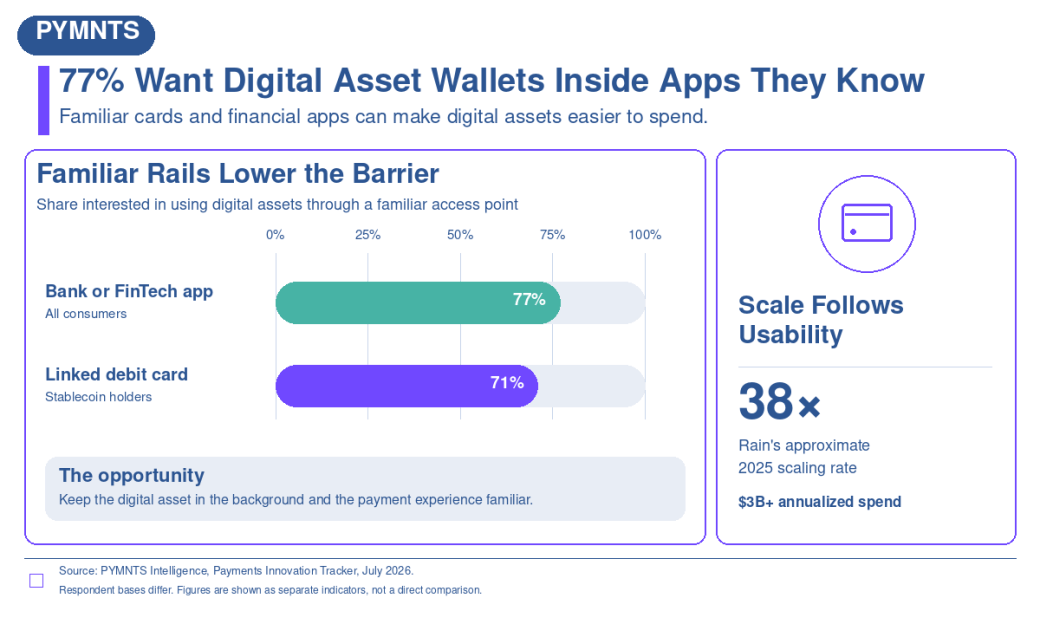
A Payments Innovation Tracker report finds that 77% of consumers would prefer a digital asset wallet from an existing financial app. Consumers show interest in using cryptocurrencies and stablecoins for payments and transfers, but merchant acceptance, trust and fragmentation remain barriers.
4:00 AMPYMNTS
8:41 PMPYMNTS
Paymentus Scales Bill Payment Platform Across Additional Sectors
Summary
Paymentus described bill presentment and payment processing as a technology platform rather than a purely transactional service. Executives outlined expansion into additional verticals and the use of agentic artificial intelligence to modernize bill payment.
Paymentus is shifting from a specialized bill-payment provider toward a broader software platform serving multiple
Unlock the full First Pass Analysis to get a better understanding of why this story matters
Why it matters
Bill payment is becoming a software competition, not just a transaction-processing business.
‘My total balance should be $20 million’: I invested $1.1 million in a crypto platform. Have I lost it all?
Summary
An investor says they put $1.1 million into a crypto platform after a recommendation from an executive vice president at a major New York investment bank. They now question whether the investment, which they believe should be worth $20 million, can be recovered.
The decisive issue is not the projected return but the breakdown in access, verification, or
Unlock the full First Pass Analysis to get a better understanding of why this story matters
Why it matters
Large investments in crypto can remain exposed to severe recovery and accountability gaps despite institutional endorsements.
Mastercard CFO Outlines Growth Strategy Driven by Stablecoins and Value-Added Services
Summary
Incoming CFO Ling Hai described Mastercard as a growth-oriented B2B technology company and outlined a capital allocation plan centered on frontline sales, targeted acquisitions and infrastructure investment. He identified stablecoins and value-added services as key sources of future growth.
Mastercard is positioning stablecoins as an extension of its payments infrastructure rather than a threat
Unlock the full First Pass Analysis to get a better understanding of why this story matters
Why it matters
Mastercard's next growth phase depends on monetizing new payment rails and services beyond card transaction volume.
Fiserv Unifies Financial and Merchant Divisions to Unlock Growth Opportunities
Summary
Fiserv plans to bring its Financial Solutions and Merchant Solutions operations together after running them as separate divisions. CEO Takis Georgakopoulos said the unified structure is intended to combine capabilities and capture additional growth opportunities.
The reorganization shifts Fiserv from a segment-based model toward integrated selling and product delivery. Success
Unlock the full First Pass Analysis to get a better understanding of why this story matters
Why it matters
Fiserv is betting that one operating model can turn its breadth across financial institutions and merchants into faster growth.
Anthropic introduced Claude for Financial Advisors, combining connectors and workflow tools for investment research, meeting preparation, and documentation. The product targets routine work that consumes advisers' time without directly replacing client judgment.
The shift moves generative AI from general productivity into regulated advisory workflows. Firms will need
Unlock the full First Pass Analysis to get a better understanding of why this story matters
Why it matters
AI is entering financial advice through operational workflows, making governance and auditability central to its commercial adoption.
U.S. Bank Recruits Citi Executive to Lead Payments in Key Growth Sectors
Summary
U.S. Bank has hired Citi veteran Calvert Lange to lead its Payments: Merchant and Institutional sales group. He will oversee payment and treasury solutions for companies in technology, media, telecommunications, automotive, transportation, consumer and hospitality sectors.
U.S. Bank is placing senior leadership behind industries where complex payment flows and treasury needs
Unlock the full First Pass Analysis to get a better understanding of why this story matters
Why it matters
Winning large industry clients can expand U.S. Bank's payments revenue and make treasury services harder for competitors to displace.
Crypto data firm Kaiko secures $110 million funding round led by S&P Global
Summary
Kaiko raised $110 million in a funding round led by S&P Global, with BNP Paribas, Nasdaq, Royal Bank of Canada and other investors participating. The crypto data provider plans to expand its data business and product offerings as financial institutions increase their involvement in digital asset markets.
Institutional investors are backing the infrastructure that supports crypto markets, not just the assets themselves.
Unlock the full First Pass Analysis to get a better understanding of why this story matters
Why it matters
Institutional crypto adoption is creating demand for specialized market data and strengthening the case for crypto infrastructure startups.
Swift defers “all payments changes” in SR2026 — and names only one of them
Summary
The article reports that Swift has deferred all payments changes planned for SR2026 while identifying only one specific change. The announcement leaves participants with limited clarity about the full scope and timing of the affected work.
The deferral creates planning risk for banks and payment firms that have tied technology, testing,
Unlock the full First Pass Analysis to get a better understanding of why this story matters
Why it matters
Unclear standards timelines can create costly rework across the global payments infrastructure.
Klarna expands Nordics anti-fraud toolkit with new live call verification tool
Summary
Klarna launched Call Status Detection in its Nordic markets, allowing users to check in the app whether an incoming caller is genuinely from Klarna. The feature is designed to counter impersonation scams conducted through phone calls.
Klarna is shifting fraud prevention from post-transaction detection toward real-time identity verification during the scam
Unlock the full First Pass Analysis to get a better understanding of why this story matters
Why it matters
Payment providers are increasingly treating trusted communications as part of the security layer, not as a separate customer-service function.
Coinbase Ramps Up AI Adoption to Support Open Finance Push
Summary
Coinbase is increasing its use of artificial intelligence as it pursues a broader open-finance strategy. The effort links automation and data capabilities to the expansion of financial services beyond a standalone crypto exchange.
AI could help Coinbase manage more products, users, and data connections as open finance increases
Unlock the full First Pass Analysis to get a better understanding of why this story matters
Why it matters
Coinbase is positioning AI as infrastructure for broader financial integration, not just as an internal productivity tool.
Beyond the PIN: How to Implement Biometrics in Modern Banking
Summary
The article examines how banks can deploy biometric authentication beyond traditional PINs. It focuses on implementation considerations for using biometric signals to secure modern banking access and transactions.
Biometrics can reduce reliance on reusable secrets, but it also creates a higher-consequence data problem
Unlock the full First Pass Analysis to get a better understanding of why this story matters
Why it matters
Biometric banking can improve security only if identity assurance and privacy protections advance together.
The Payments Association appoints Daniel Jonas global ambassador
Summary
The Payments Association appointed Daniel Jonas as Global Ambassador and tasked him with leading a new Global Payments Infrastructure working group. The group will focus on building safer, more resilient, and interoperable payment systems.
The appointment puts infrastructure coordination, rather than individual payment products, at the center of the
Unlock the full First Pass Analysis to get a better understanding of why this story matters
Why it matters
Payments growth increasingly depends on shared infrastructure and rules that allow systems to connect reliably across markets.
Tokenovate executes intra-day repo transaction on Canton Network
Summary
Tokenovate completed and settled an intra-day repurchase agreement on the Canton Network using the FINOS Common Domain Model. The transaction used Circle-issued USDC, represented as USDCx Reserve on the network, for cash settlement.
The transaction moves tokenized repo from infrastructure testing toward a more concrete post-trade use case.
Unlock the full First Pass Analysis to get a better understanding of why this story matters
Why it matters
Institutional markets are testing whether tokenized cash and standardized workflows can make short-term financing faster and less operationally expensive.
SmartTrade launched smartTrade Flow, a post-trade platform covering middle-office controls and back-office fulfillment from the point of front-office execution.
The platform expands SmartTrade beyond execution into the operational processes that create reconciliation, control, and
Unlock the full First Pass Analysis to get a better understanding of why this story matters
Why it matters
Post-trade automation targets a costly operational gap where fragmented systems still create risk after a transaction is executed.
A buy now, pay later stock has been sliding. It's worth scooping up, Wolfe Research says
Summary
Wolfe Research upgraded a declining buy now, pay later stock to outperform from peer perform. The firm sees the recent share-price weakness as an opportunity rather than evidence that the company's outlook has deteriorated.
The upgrade shifts the debate from near-term stock momentum to whether the selloff has overshot
Unlock the full First Pass Analysis to get a better understanding of why this story matters
Why it matters
The recommendation tests whether investors still view BNPL as a growth market rather than a rising consumer-credit risk.
Study Finds Credit Card Loyalty Is More Fragile Than It Looks
Summary
A PYMNTS Intelligence study produced with Elan finds that consumers can quickly move a credit card from top choice to backup. Once another card takes the leading position in a wallet, future spending often follows it.
The decisive shift is that card loyalty depends less on account tenure than on maintaining
Unlock the full First Pass Analysis to get a better understanding of why this story matters
Why it matters
Card issuers risk losing spending share long before customers formally leave.
Mastercard’s Sherri Haymond on Letting AI Shop While Consumers Stay in Charge
Summary
Mastercard executive Sherri Haymond discusses AI agents that can search for products, compare prices and complete purchases. The central challenge is giving agents authority to act across merchants while preserving consumer control.
The shift from AI-assisted shopping to AI-authorized purchasing makes consent, authentication and transaction limits core
Unlock the full First Pass Analysis to get a better understanding of why this story matters
Why it matters
Agentic commerce will scale only if payment systems make delegated authority as trustworthy as direct consumer action.
77% Would Choose Their Existing Financial App for a Digital Asset Wallet
Summary
A Payments Innovation Tracker report finds that 77% of consumers would prefer a digital asset wallet from an existing financial app. Consumers show interest in using cryptocurrencies and stablecoins for payments and transfers, but merchant acceptance, trust and fragmentation remain barriers.
The strongest adoption path is integration into financial products consumers already use, not a separate
Unlock the full First Pass Analysis to get a better understanding of why this story matters
Why it matters
Digital assets are more likely to become payment tools when incumbents hide the complexity behind familiar financial apps.