
European wealthtech funding fell 46% in the second quarter as investors adopted a more cautious approach.
8:28 AMFinextra22 stories from 5 sources
Supporting Articles
European wealthtech funding fell 46% in the second quarter as investors adopted a more cautious approach.
8:28 AMFinextraFunding for fintech companies across EMEA declined sharply in the first half of the year as investors became more selective.
5:38 AMFinextra
Citi and DBS completed a Singapore-to-U.S. dollar payment over a weekend using tokenized deposits on the Swift Digital Ledger. The transaction demonstrates a way to process cross-border dollar payments outside standard banking hours.
2:55 PMPYMNTSRevolut has received conditional approval from the US Office of the Comptroller of the Currency for a banking charter, marking a step toward a regulated US banking operation.
7:54 AMFinextra
House Republican leaders canceled voting sessions for the final two weeks of September, removing eight legislative days and moving the chamber's planned departure to Sept. 17. The compressed schedule leaves a crypto regulation bill with less time to clear the House and face the Senate.
4:01 AMPYMNTSAnthropic’s Claude shopping agent shows that AI can now handle much of the product-discovery and purchasing workflow at lower operating cost. Payments remain the unresolved layer, limiting how independently these agents can complete transactions.
9:50 AMFinextraThe article examines the governance problem created when AI-enabled banking APIs move beyond executing instructions and begin making operational or financial decisions.
6:36 AMFinextraAmazon has agreed to sell its Middle East and North Africa payments operations to Saudi Arabia-based PayTabs for $100 million.
9:44 AMFinextraSummary
European wealthtech funding fell 46% in the second quarter as investors adopted a more cautious approach.
The 46% drop signals a sharper funding squeeze for wealthtech firms, particularly those that still
Unlock the full First Pass Analysis to get a better understanding of why this story mattersWhy it matters
Lower funding will push European wealthtechs to extend cash runways, narrow product bets and prioritise profitability over rapid expansion.
Summary
Funding for fintech companies across EMEA declined sharply in the first half of the year as investors became more selective.
Selective investing is tightening access to capital across the region, with weaker or less differentiated
Unlock the full First Pass Analysis to get a better understanding of why this story mattersWhy it matters
A weaker funding market can accelerate consolidation across EMEA fintech and reduce the number of firms able to pursue aggressive growth.
Summary
Citi and DBS completed a Singapore-to-U.S. dollar payment over a weekend using tokenized deposits on the Swift Digital Ledger. The transaction demonstrates a way to process cross-border dollar payments outside standard banking hours.
The transaction breaks the weekday and time-zone constraints that still shape cross-border dollar payments. Tokenized
Unlock the full First Pass Analysis to get a better understanding of why this story mattersWhy it matters
Around-the-clock settlement could reduce the working-capital costs and operational risk created by closed payment windows.
Summary
Revolut has received conditional approval from the US Office of the Comptroller of the Currency for a banking charter, marking a step toward a regulated US banking operation.
The approval would give Revolut a clearer path to offer banking services in the US
Unlock the full First Pass Analysis to get a better understanding of why this story mattersWhy it matters
Revolut is moving from fintech expansion toward bank-level regulatory accountability in the US.
Summary
House Republican leaders canceled voting sessions for the final two weeks of September, removing eight legislative days and moving the chamber's planned departure to Sept. 17. The compressed schedule leaves a crypto regulation bill with less time to clear the House and face the Senate.
The shortened calendar turns timing into the bill's immediate obstacle. Supporters must move it through
Unlock the full First Pass Analysis to get a better understanding of why this story mattersWhy it matters
The calendar, not just the bill's policy content, may determine whether crypto regulation advances this year.
Summary
Anthropic’s Claude shopping agent shows that AI can now handle much of the product-discovery and purchasing workflow at lower operating cost. Payments remain the unresolved layer, limiting how independently these agents can complete transactions.
The cost of deploying shopping agents is falling, shifting the main constraint from model economics
Unlock the full First Pass Analysis to get a better understanding of why this story mattersWhy it matters
Cheaper agents could accelerate automated shopping, but payment infrastructure will determine whether they can actually close sales.
Summary
The article examines the governance problem created when AI-enabled banking APIs move beyond executing instructions and begin making operational or financial decisions.
Decision-making APIs shift responsibility from software users to the institutions that design, deploy, and supervise
Unlock the full First Pass Analysis to get a better understanding of why this story mattersWhy it matters
As banking software gains discretion, accountability becomes a product requirement rather than a back-office concern.
Summary
Amazon has agreed to sell its Middle East and North Africa payments operations to Saudi Arabia-based PayTabs for $100 million.
The deal transfers Amazon's regional payments infrastructure and merchant relationships to a local fintech operator.
Unlock the full First Pass Analysis to get a better understanding of why this story mattersWhy it matters
A major global platform is handing regional payments assets to a Saudi challenger, reshaping competition in MENA.
A curated list of other prominent stories from this day.

Six Flags is partnering with Upgrade to offer Flex Pay, allowing guests to purchase season passes through fixed monthly installments. The program extends buy now, pay later financing to recurring amusement park access.
4:18 PMPYMNTS
Mastercard is partnering with Kenya-based Flowcart to embed card payments into social and conversational commerce. The companies aim to make purchases more direct and secure as consumers discover products through social channels.
3:57 PMPYMNTS
Overseas fintech platforms let Indians convert stablecoins and other crypto assets into gift cards and vouchers usable for groceries, fuel, gold and other domestic purchases. The arrangement relies on foreign platforms and Indian voucher partners, raising questions about cross-border payments, taxation and anti-money-laundering controls.
3:42 PMEconomic Times
UK regulators have discussed easing the country’s seven-year-old ban on prediction markets as consumers increasingly use US-based platforms such as Kalshi and Polymarket. The talks could lead to a regulated domestic framework rather than leaving this activity with offshore providers.
12:48 PMPYMNTSThe article examines the European Business Wallet under eIDAS 2.0 and presents six questions financial institutions should address before 2026. It frames the wallet as a developing infrastructure for digital identity, credentials and business transactions.
12:30 PMFinextraConcryt has deployed agentic AI across its live payment operations to monitor its payment gateway beyond a conventional chatbot interface.
9:16 AMFinextraDNA Payments has partnered with iwoca to let its merchants apply for Flexi Loans ranging from £1,000 to £1 million through the DNA Merchant Portal and App.
9:14 AMFinextraXpate has launched xpate Pro, an API-based service that lets businesses manage accounts, initiate transfers, and access financial reporting within their own systems.
9:12 AMFinextra
Truss Financial is expanding its hybrid lending model by bringing underwriting and funding in-house through a new direct lending platform. The move is intended to reduce loan turnaround times.
9:00 AMHousing WireEuroclear and HSBC have announced AutoFX, an automated foreign-exchange service designed to support settlement workflows affected by shorter settlement timelines.
8:25 AMFinextraReal-world asset tokenization is changing how traditional assets are issued, owned, and managed. The article focuses on the infrastructure required to support these processes at enterprise scale.
6:27 AMFinextra
Miles & More, Currensea and Mastercard have launched a debit card for UK customers that links everyday spending with Miles & More loyalty rewards.
6:22 AMBreaking Travel NewsMid-tier banks face two unattractive choices as they modernize: continue investing in legacy platforms or pursue a difficult transition to newer technology. The article examines the strategic constraints behind that modernization dilemma.
5:55 AMFinextra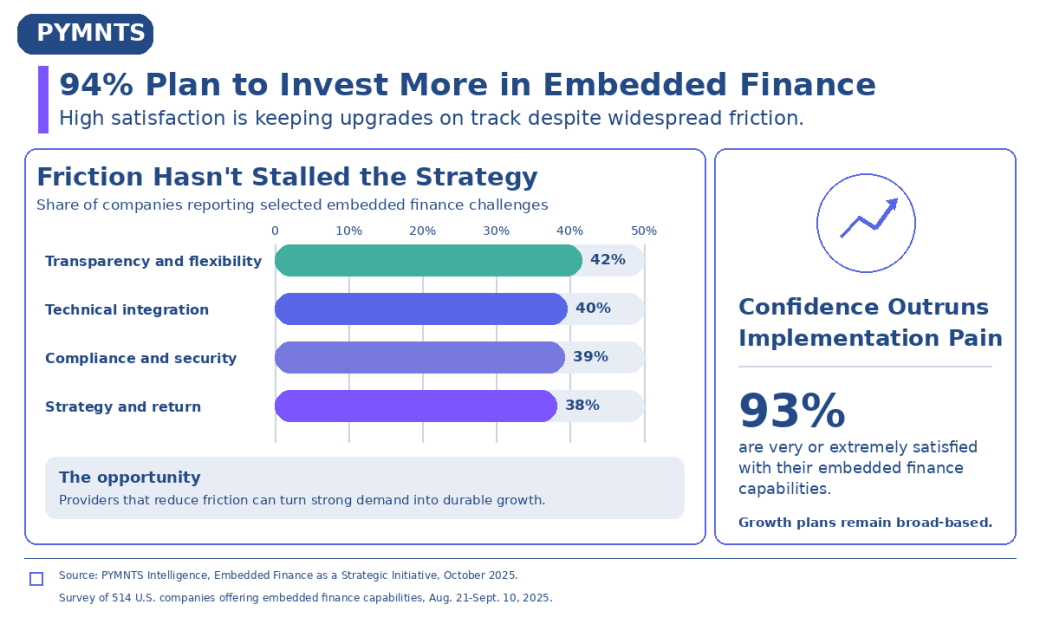
Sixty-one percent of companies plan to make payroll benefits their next embedded finance priority. The push comes even as 93% of firms report friction with financial tools integrated into customer or employee platforms.
4:00 AMPYMNTSSummary
Six Flags is partnering with Upgrade to offer Flex Pay, allowing guests to purchase season passes through fixed monthly installments. The program extends buy now, pay later financing to recurring amusement park access.
Six Flags is shifting season-pass purchases from an upfront expense to a financed commitment. Families
Unlock the full First Pass Analysis to get a better understanding of why this story mattersWhy it matters
BNPL is becoming a broader pricing and distribution tool for consumer services, not just a checkout option for goods.
Summary
Mastercard is partnering with Kenya-based Flowcart to embed card payments into social and conversational commerce. The companies aim to make purchases more direct and secure as consumers discover products through social channels.
The partnership moves card acceptance into the messaging and social environments where African shoppers increasingly
Unlock the full First Pass Analysis to get a better understanding of why this story mattersWhy it matters
Payment networks are competing to own commerce at the point of discovery, before shoppers reach a traditional online checkout.
Summary
Overseas fintech platforms let Indians convert stablecoins and other crypto assets into gift cards and vouchers usable for groceries, fuel, gold and other domestic purchases. The arrangement relies on foreign platforms and Indian voucher partners, raising questions about cross-border payments, taxation and anti-money-laundering controls.
Crypto spending is reaching Indian merchants without passing through a conventional domestic crypto-payment system. That
Unlock the full First Pass Analysis to get a better understanding of why this story mattersWhy it matters
The model creates a practical crypto-to-commerce channel while testing the limits of India’s payment, tax and AML frameworks.
Summary
UK regulators have discussed easing the country’s seven-year-old ban on prediction markets as consumers increasingly use US-based platforms such as Kalshi and Polymarket. The talks could lead to a regulated domestic framework rather than leaving this activity with offshore providers.
The decisive shift is that offshore usage is pressuring regulators to reconsider an outright ban.
Unlock the full First Pass Analysis to get a better understanding of why this story mattersWhy it matters
A policy reversal could give prediction markets a foothold in the UK while setting a regulatory model other jurisdictions may copy.
Summary
The article examines the European Business Wallet under eIDAS 2.0 and presents six questions financial institutions should address before 2026. It frames the wallet as a developing infrastructure for digital identity, credentials and business transactions.
The decisive shift is that digital identity is moving toward a standardized, reusable wallet model
Unlock the full First Pass Analysis to get a better understanding of why this story mattersWhy it matters
The wallet could make trusted business identity a shared utility across European financial services.
Summary
Concryt has deployed agentic AI across its live payment operations to monitor its payment gateway beyond a conventional chatbot interface.
The shift puts AI inside operational monitoring, where it can detect issues and potentially support
Unlock the full First Pass Analysis to get a better understanding of why this story mattersWhy it matters
Agentic AI is moving from customer interaction into the control layer of payments infrastructure.
Summary
DNA Payments has partnered with iwoca to let its merchants apply for Flexi Loans ranging from £1,000 to £1 million through the DNA Merchant Portal and App.
The partnership embeds working-capital access directly into a payments relationship. DNA can deepen its value
Unlock the full First Pass Analysis to get a better understanding of why this story mattersWhy it matters
Payment providers are moving upstream into lending by turning transaction relationships into financing channels.
Summary
Xpate has launched xpate Pro, an API-based service that lets businesses manage accounts, initiate transfers, and access financial reporting within their own systems.
Xpate is shifting money management from standalone banking interfaces into embedded workflows. That gives platforms
Unlock the full First Pass Analysis to get a better understanding of why this story mattersWhy it matters
Financial operations are becoming programmable infrastructure rather than a separate banking destination.
Summary
Truss Financial is expanding its hybrid lending model by bringing underwriting and funding in-house through a new direct lending platform. The move is intended to reduce loan turnaround times.
The shift gives Truss more control over two bottlenecks that typically sit outside a broker-led
Unlock the full First Pass Analysis to get a better understanding of why this story mattersWhy it matters
Mortgage platforms are moving closer to the lender role to gain speed, control economics, and reduce dependence on third-party capital.
Summary
Euroclear and HSBC have announced AutoFX, an automated foreign-exchange service designed to support settlement workflows affected by shorter settlement timelines.
AutoFX targets the operational gap created when securities settle faster but currency conversion remains manual
Unlock the full First Pass Analysis to get a better understanding of why this story mattersWhy it matters
Faster securities settlement is forcing the foreign-exchange infrastructure that supports it to become more automated.
Summary
Real-world asset tokenization is changing how traditional assets are issued, owned, and managed. The article focuses on the infrastructure required to support these processes at enterprise scale.
The decisive shift is from tokenization as a product concept to tokenization as an operational
Unlock the full First Pass Analysis to get a better understanding of why this story mattersWhy it matters
Tokenization will scale only if its underlying infrastructure can meet the control and reliability standards of traditional financial markets.
Summary
Miles & More, Currensea and Mastercard have launched a debit card for UK customers that links everyday spending with Miles & More loyalty rewards.
The launch extends airline loyalty into payments, giving Miles & More a new channel to
Unlock the full First Pass Analysis to get a better understanding of why this story mattersWhy it matters
Airline loyalty programmes are using fintech partnerships to turn routine spending into a source of customer retention and revenue.
Summary
Mid-tier banks face two unattractive choices as they modernize: continue investing in legacy platforms or pursue a difficult transition to newer technology. The article examines the strategic constraints behind that modernization dilemma.
The core problem is that mid-tier banks must fund modernization while remaining dependent on systems
Unlock the full First Pass Analysis to get a better understanding of why this story mattersWhy it matters
Technology decisions are becoming a balance-sheet and competitiveness issue for banks that lack the scale of larger institutions.
Summary
Sixty-one percent of companies plan to make payroll benefits their next embedded finance priority. The push comes even as 93% of firms report friction with financial tools integrated into customer or employee platforms.
The combination of widespread friction and continued investment shows that companies view embedded finance problems
Unlock the full First Pass Analysis to get a better understanding of why this story mattersWhy it matters
Embedded finance is moving deeper into workplace payments despite unresolved technology and implementation problems.
Make it yours
Pick your topics, set your cadence, and receive your personalized First Pass in your inbox. It’s that simple!