
Walmart will begin enabling tap-to-pay at selected Walmart and Sam's Club locations on August 24. The company plans to extend the option to all US stores and clubs over time.
1:09 PMPYMNTS27 stories from 8 sources
Supporting Articles
Walmart will begin enabling tap-to-pay at selected Walmart and Sam's Club locations on August 24. The company plans to extend the option to all US stores and clubs over time.
1:09 PMPYMNTS
The SEC has proposed new rules for investment contracts involving digital assets, seeking to create a regulatory framework for crypto-related offerings. The proposal would clarify how securities requirements apply to certain digital asset arrangements.
7:28 AMFinextra
Standard Chartered and HSBC completed the first live interbank transaction on Swift’s blockchain-based ledger. The cross-border payment demonstrated interoperability and advanced the use of regulated tokenized deposits toward 24/7 settlement.
7:42 PMPYMNTSPolice inquiries involving Binance employees in the United Arab Emirates are examining a bank account used by the exchange to hold customer funds. The investigation puts pressure on one of Binance's most important operating bases.
4:01 PMBloomberg Markets
Prediction markets such as Kalshi face different regulatory treatment across states, creating uncertainty over where and how they can operate. The conflict raises broader questions about whether state authorities or federal regulators should oversee these platforms.
12:14 PMMarketWatch
Executives from traditional exchanges, crypto firms, and prediction-market platforms disagreed over how regulators should address manipulation and insider trading in event contracts. The debate exposed a widening divide over whether existing derivatives rules adequately fit newer prediction-market models.
11:50 AMPYMNTS
Stablecoins are increasingly being used behind the scenes across payroll, merchant acquiring, card networks, creator payments, and corporate treasury. Their value proposition is shifting from a customer-facing alternative to cash toward infrastructure that settles transactions without requiring users to handle crypto directly.
2:17 PMPYMNTS
Eskimo will allow customers to pay for its global eSIM plans with stablecoins through a partnership with payment institution Triple-A. The move adds a digital asset payment option to a travel connectivity service used across borders.
4:18 AMBreaking Travel News
Payload has secured a strategic investment led by Fifth Third to expand its embedded payments platform. The company says it processed nearly $500 million in payments in May and has become a leading processor of earnest money deposits.
8:26 PMPYMNTSSummary
Walmart will begin enabling tap-to-pay at selected Walmart and Sam's Club locations on August 24. The company plans to extend the option to all US stores and clubs over time.
The rollout turns contactless payment from a missing feature into a national infrastructure project for
Unlock the full First Pass Analysis to get a better understanding of why this story mattersWhy it matters
Walmart's nationwide rollout could make contactless payment a default expectation at US retail checkout.
3 stories · 3 sources
Summary
The SEC has proposed new rules for investment contracts involving digital assets, seeking to create a regulatory framework for crypto-related offerings. The proposal would clarify how securities requirements apply to certain digital asset arrangements.
A formal proposal shifts the US crypto debate toward defined regulatory treatment, but it does
Unlock the full First Pass Analysis to get a better understanding of why this story mattersWhy it matters
Clearer SEC rules could reduce uncertainty for compliant firms while raising costs and legal risk for crypto businesses outside the framework.
Summary
Standard Chartered and HSBC completed the first live interbank transaction on Swift’s blockchain-based ledger. The cross-border payment demonstrated interoperability and advanced the use of regulated tokenized deposits toward 24/7 settlement.
A blockchain-based ledger has moved from industry concept to a live transaction between two major
Unlock the full First Pass Analysis to get a better understanding of why this story mattersWhy it matters
The transaction gives banks a concrete path to test always-on cross-border payments using regulated digital money.
Summary
Police inquiries involving Binance employees in the United Arab Emirates are examining a bank account used by the exchange to hold customer funds. The investigation puts pressure on one of Binance's most important operating bases.
The scrutiny reaches beyond individual employees because it concerns the handling of customer money. UAE
Unlock the full First Pass Analysis to get a better understanding of why this story mattersWhy it matters
A compliance investigation in Binance's key UAE hub could test whether the region can combine crypto growth with credible financial safeguards.
2 stories · 2 sources
Summary
Prediction markets such as Kalshi face different regulatory treatment across states, creating uncertainty over where and how they can operate. The conflict raises broader questions about whether state authorities or federal regulators should oversee these platforms.
The regulatory split is becoming a structural threat to prediction markets, not just a compliance
Unlock the full First Pass Analysis to get a better understanding of why this story mattersWhy it matters
A prolonged jurisdiction fight could delay mainstream adoption and make regulatory risk a core cost of running a prediction market.
Summary
Executives from traditional exchanges, crypto firms, and prediction-market platforms disagreed over how regulators should address manipulation and insider trading in event contracts. The debate exposed a widening divide over whether existing derivatives rules adequately fit newer prediction-market models.
The core dispute is no longer whether prediction markets need oversight, but which market rules
Unlock the full First Pass Analysis to get a better understanding of why this story mattersWhy it matters
Unresolved rules around manipulation and insider trading could limit institutional participation and invite tougher enforcement.
Summary
Stablecoins are increasingly being used behind the scenes across payroll, merchant acquiring, card networks, creator payments, and corporate treasury. Their value proposition is shifting from a customer-facing alternative to cash toward infrastructure that settles transactions without requiring users to handle crypto directly.
The decisive shift is that stablecoin adoption can grow even when customers never know they
Unlock the full First Pass Analysis to get a better understanding of why this story mattersWhy it matters
Stablecoins may become important to payments by disappearing into the financial infrastructure customers already use.
Summary
Eskimo will allow customers to pay for its global eSIM plans with stablecoins through a partnership with payment institution Triple-A. The move adds a digital asset payment option to a travel connectivity service used across borders.
Stablecoins are moving from trading platforms into routine travel purchases, where cross-border settlement can offer
Unlock the full First Pass Analysis to get a better understanding of why this story mattersWhy it matters
The partnership tests whether stablecoins can solve practical cross-border payment problems outside financial services.
Summary
Payload has secured a strategic investment led by Fifth Third to expand its embedded payments platform. The company says it processed nearly $500 million in payments in May and has become a leading processor of earnest money deposits.
Fifth Third’s investment gives Payload additional capital and a major bank partner as it scales
Unlock the full First Pass Analysis to get a better understanding of why this story mattersWhy it matters
The deal shows banks are using strategic investments to secure positions in the infrastructure powering embedded financial services.
A curated list of other prominent stories from this day.

Coupa’s Payment Batch Creation Agent independently prepared 14 payment batches covering 2,395 individual payments. The system automated the matching and grouping work, but people still retained final approval authority.
7:12 PMPYMNTS
Some universities will begin accepting tuition payments through Venmo as consumers seek more flexible ways to spend and transfer money. The option adds convenience but raises questions about fees, limits, and payment safeguards.
5:20 PMMarketWatch
Card-issuing platforms are expanding beyond card processing as their fintech customers enter more markets and payment use cases. Their broader strategy is to monetize existing relationships by adding alternative payment rails and related infrastructure.
5:15 PMPYMNTS
Instant payments can let businesses separate the timing of payment initiation from the moment funds must leave their accounts. That flexibility allows treasury teams to pay closer to the contractual deadline without relying on settlement float or sending cash days early.
11:38 AMPYMNTSBanks often develop strong strategies but underestimate the operational work required to execute them. Fred Slevin of ACI Worldwide argues that success depends less on budget size than on translating plans into clear, deliverable actions.
11:00 AMFinextra
A Columbia professor argues that banks' opposition to the Clarity Act relies on weak consumer-protection claims and reflects an effort to preserve existing advantages. The campaign could instead expose the industry's resistance to rules that would broaden competition and reshape digital-asset markets.
10:26 AMFortune
Upstox has surpassed 2 crore demat accounts, with 85% of its customers based in Tier-II and Tier-III cities and 70% identified as first-time investors. The platform is targeting 10 crore users within five years and is reportedly considering a $350 million to $400 million IPO.
8:09 AMEconomic TimesThe article argues that the challenger-bank category has lost its meaning because several challengers have matured into mainstream financial institutions. The original incumbents now face pressure not only from fintechs, but from customers' changed expectations about digital banking.
7:18 AMFinextraDBS will deploy agentic AI services to about 1,500 bankers globally to support corporate credit assessments. The tools are intended to assist employees with a process that requires analysis of borrower information and risk.
6:22 AMFinextraFE fundinfo has expanded its Nexus for Financial Advisers platform into the Republic of Ireland with a Gross Cashflow modeller that incorporates local tax considerations. The tool is designed to support tax-aware financial planning for Irish advisers.
6:03 AMFinextraBuilding a cross-border payments platform involves far more than exposing an API. End-to-end routing requires coordination across payment rails, compliance controls, liquidity, settlement, local partners, and exception handling.
5:20 AMFinextraAs instant payment systems become widespread, speed is losing its power as a differentiator. The article examines the other factors that can shape payment competitiveness once settlement time is broadly comparable.
4:50 AMFinextra
Banks are redesigning payment infrastructure for transactions initiated by software agents rather than people. The shift will require new approaches to authorization, security and the systems that support AI-driven purchasing.
4:03 AMPYMNTS
Credit unions are adopting chatbots at a much faster rate, with reported adoption rising from 3% to 46%. The larger challenge is meeting business members' growing demand for AI-enabled service when many institutions still lack the capabilities to deliver it.
4:01 AMPYMNTS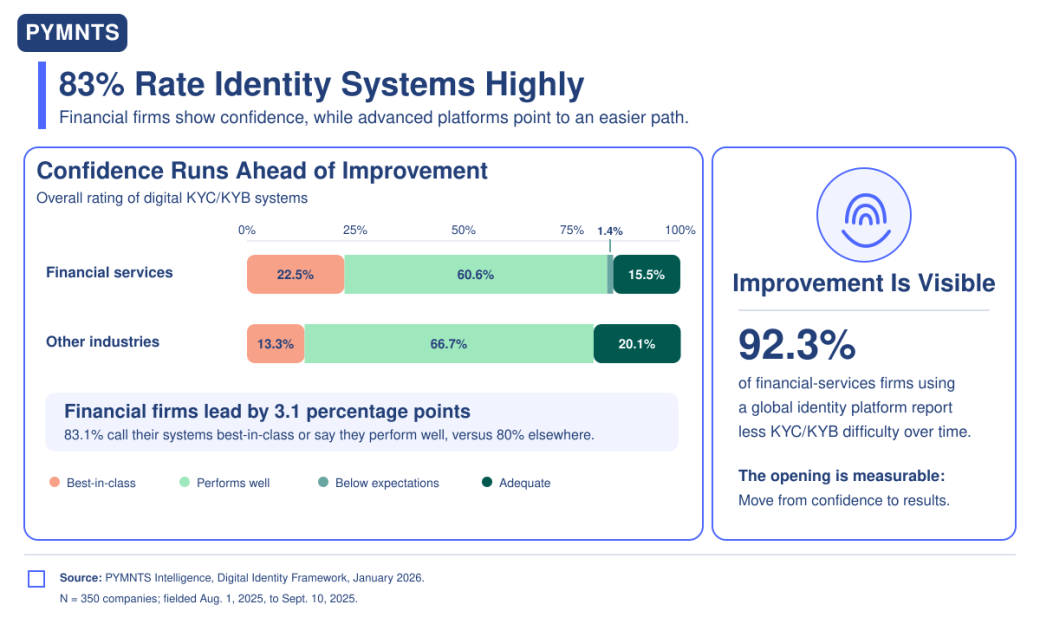
A survey of 350 companies found that 83% of financial firms rate their digital identity systems highly, even as customers continue to encounter friction. The findings examine identity verification across financial services and other industries amid increased use of bots and software agents.
4:00 AMPYMNTSSummary
Coupa’s Payment Batch Creation Agent independently prepared 14 payment batches covering 2,395 individual payments. The system automated the matching and grouping work, but people still retained final approval authority.
The key shift is operational scale: an AI agent can now assemble thousands of payments
Unlock the full First Pass Analysis to get a better understanding of why this story mattersWhy it matters
Payment automation is advancing faster than delegated authority, making governance the constraint on broader AI adoption.
Summary
Some universities will begin accepting tuition payments through Venmo as consumers seek more flexible ways to spend and transfer money. The option adds convenience but raises questions about fees, limits, and payment safeguards.
Universities are treating peer-to-peer payment networks as part of mainstream tuition infrastructure. Families may gain
Unlock the full First Pass Analysis to get a better understanding of why this story mattersWhy it matters
Peer-to-peer apps are moving into high-value institutional payments, where convenience must compete with security and consumer protections.
Summary
Card-issuing platforms are expanding beyond card processing as their fintech customers enter more markets and payment use cases. Their broader strategy is to monetize existing relationships by adding alternative payment rails and related infrastructure.
The decisive shift is from card infrastructure to broader payments platforms. As fintech customers operate
Unlock the full First Pass Analysis to get a better understanding of why this story mattersWhy it matters
Global fintech growth is turning card processors into broader payment infrastructure companies.
Summary
Instant payments can let businesses separate the timing of payment initiation from the moment funds must leave their accounts. That flexibility allows treasury teams to pay closer to the contractual deadline without relying on settlement float or sending cash days early.
The main financial benefit of instant payments may be better control of cash timing rather
Unlock the full First Pass Analysis to get a better understanding of why this story mattersWhy it matters
Real-time settlement can convert payment timing into a source of measurable liquidity and reduce the cost of idle cash.
Summary
Banks often develop strong strategies but underestimate the operational work required to execute them. Fred Slevin of ACI Worldwide argues that success depends less on budget size than on translating plans into clear, deliverable actions.
Execution, not funding, is the binding constraint for many bank transformation programs. Institutions that align
Unlock the full First Pass Analysis to get a better understanding of why this story mattersWhy it matters
Large technology budgets cannot compensate for unclear accountability and poor execution.
Summary
A Columbia professor argues that banks' opposition to the Clarity Act relies on weak consumer-protection claims and reflects an effort to preserve existing advantages. The campaign could instead expose the industry's resistance to rules that would broaden competition and reshape digital-asset markets.
The fight is becoming a test of whether banks can frame incumbent protection as consumer
Unlock the full First Pass Analysis to get a better understanding of why this story mattersWhy it matters
The Clarity Act could determine whether digital-asset competition expands under clearer rules or remains constrained by incumbent influence.
Summary
Upstox has surpassed 2 crore demat accounts, with 85% of its customers based in Tier-II and Tier-III cities and 70% identified as first-time investors. The platform is targeting 10 crore users within five years and is reportedly considering a $350 million to $400 million IPO.
Upstox's user base shows that online investing has moved well beyond India's largest cities, but
Unlock the full First Pass Analysis to get a better understanding of why this story mattersWhy it matters
Upstox's expansion is a test of whether India's retail investing boom can support large, profitable digital brokerage platforms.
Summary
The article argues that the challenger-bank category has lost its meaning because several challengers have matured into mainstream financial institutions. The original incumbents now face pressure not only from fintechs, but from customers' changed expectations about digital banking.
The competitive shift is from challenger versus incumbent to relevance versus irrelevance. Successful challengers must
Unlock the full First Pass Analysis to get a better understanding of why this story mattersWhy it matters
Fintech disruption has moved beyond market entry and into the harder contest for durable customer relationships.
Summary
DBS will deploy agentic AI services to about 1,500 bankers globally to support corporate credit assessments. The tools are intended to assist employees with a process that requires analysis of borrower information and risk.
DBS is applying agentic AI to a controlled, high-value workflow rather than using it as
Unlock the full First Pass Analysis to get a better understanding of why this story mattersWhy it matters
The deployment shows banks moving AI from experimentation into credit operations, where efficiency gains must be balanced against underwriting risk.
Summary
FE fundinfo has expanded its Nexus for Financial Advisers platform into the Republic of Ireland with a Gross Cashflow modeller that incorporates local tax considerations. The tool is designed to support tax-aware financial planning for Irish advisers.
The Irish launch turns Nexus from a UK-focused planning tool into a platform with market-specific
Unlock the full First Pass Analysis to get a better understanding of why this story mattersWhy it matters
Tax-aware software is becoming a competitive requirement as financial advice platforms expand across jurisdictions.
Summary
Building a cross-border payments platform involves far more than exposing an API. End-to-end routing requires coordination across payment rails, compliance controls, liquidity, settlement, local partners, and exception handling.
The decisive challenge is orchestration across fragmented infrastructure, not API design. Platforms must choose routes
Unlock the full First Pass Analysis to get a better understanding of why this story mattersWhy it matters
Cross-border payments remain an infrastructure and risk-management problem disguised as a software problem.
Summary
As instant payment systems become widespread, speed is losing its power as a differentiator. The article examines the other factors that can shape payment competitiveness once settlement time is broadly comparable.
The advantage is shifting from faster movement of money to better outcomes around the transaction.
Unlock the full First Pass Analysis to get a better understanding of why this story mattersWhy it matters
Instant payments commoditize speed and raise the value of reliability, control, and customer protection.
Summary
Banks are redesigning payment infrastructure for transactions initiated by software agents rather than people. The shift will require new approaches to authorization, security and the systems that support AI-driven purchasing.
The decisive change is that the payer may soon be an autonomous agent, forcing banks
Unlock the full First Pass Analysis to get a better understanding of why this story mattersWhy it matters
AI commerce could make payment security and authorization a systems problem, not just a customer authentication problem.
Summary
Credit unions are adopting chatbots at a much faster rate, with reported adoption rising from 3% to 46%. The larger challenge is meeting business members' growing demand for AI-enabled service when many institutions still lack the capabilities to deliver it.
The key shift is from AI awareness to an execution gap between member expectations and
Unlock the full First Pass Analysis to get a better understanding of why this story mattersWhy it matters
Fast chatbot rollout is raising the cost of underinvestment in the operational systems behind AI service.
Summary
A survey of 350 companies found that 83% of financial firms rate their digital identity systems highly, even as customers continue to encounter friction. The findings examine identity verification across financial services and other industries amid increased use of bots and software agents.
The central problem is a confidence gap: firms judge identity systems favorably while customer experience
Unlock the full First Pass Analysis to get a better understanding of why this story mattersWhy it matters
Strong internal ratings will not protect financial firms if identity controls undermine conversion and trust.
Make it yours
Pick your topics, set your cadence, and receive your personalized First Pass in your inbox. It’s that simple!
