Fintech tightens regulation while testing tokenized infrastructure
Day’s Recap
“
”
Supporting Articles
New York sued Kalshi, arguing that its prediction markets constitute illegal gambling and fall under state gaming laws. The case is part of a broader dispute between states and the federal government over who has authority to regulate these markets.
1:52 PMAl Jazeera
Project Agorá's real-value testing found that tokenized wholesale cross-border payments moved from initiation to settlement in about 80 seconds on average. The Bank for International Settlements conducted the test with public- and private-sector participants in a controlled environment.
5:53 PMPYMNTS
Coinbase shares fell after the company reported a disappointing quarterly loss amid another difficult crypto market. Analysts attributed the miss primarily to weaker market conditions rather than deterioration in Coinbase's core business.
1:21 PMCNBC
Coinbase missed Wall Street's revenue and earnings forecasts for the third consecutive quarter, sending its shares lower.
5:50 AMCNBC
Circle Internet Group said its Circle Internet Trust Company has received a limited purpose trust charter from the New York Department of Financial Services. The charter gives Circle a New York-regulated entity for its trust company operations.
11:33 AMFinextra
Chime Financial plans to eliminate about 150 jobs, representing roughly 10% of its workforce, according to a memo from CEO Chris Britt. The cuts are part of a shift toward using artificial intelligence more broadly across the company.
1:58 PMPYMNTS
Lineage Bank, a former banking partner of bankrupt banking-as-a-service provider Synapse, entered a consent order with the Federal Deposit Insurance Corporation. The bank consented without admitting or denying the charges.
7:29 PMPYMNTS
Lloyds Banking Group completed three live transactions using tokenised deposits through Project Agorá, a broader initiative focused on modernising payments and settlement.
6:35 AMFinextra
Clear Street is launching a private markets platform that will initially offer investors access to stakes in Databricks, the late-stage AI software company valued at $188 billion.
5:49 PMCNBC
1:52 PMAl Jazeera
New York sues Kalshi, says its prediction markets are ‘illegal gambling’
Summary
New York sued Kalshi, arguing that its prediction markets constitute illegal gambling and fall under state gaming laws. The case is part of a broader dispute between states and the federal government over who has authority to regulate these markets.
New York's lawsuit adds a major state-level challenge to Kalshi's legal model. If states prevail,
Unlock the full First Pass Analysis to get a better understanding of why this story matters
Why it matters
The case could determine whether prediction markets operate as federally supervised financial venues or state-regulated gambling businesses.
New York sues Kalshi for allegedly running an ‘illegal gambling operation’
Summary
New York Attorney General Letitia James sued Kalshi, alleging that the prediction market accepts wagers without a license from the state's gaming commission. The state says Kalshi is operating an illegal gambling business under New York law.
The lawsuit directly challenges Kalshi's claim that its contracts belong under federal commodities regulation rather
Unlock the full First Pass Analysis to get a better understanding of why this story matters
Why it matters
Kalshi's expansion depends on resolving whether its event contracts are financial products or bets subject to state gaming law.
Project Agorá Cuts Cross-Border Payment Times to 80 Seconds
Summary
Project Agorá's real-value testing found that tokenized wholesale cross-border payments moved from initiation to settlement in about 80 seconds on average. The Bank for International Settlements conducted the test with public- and private-sector participants in a controlled environment.
The result provides evidence that tokenization can sharply reduce settlement times, but it remains a
Unlock the full First Pass Analysis to get a better understanding of why this story matters
Why it matters
Faster settlement could reduce friction in global payments, while exposing gaps in infrastructure and cross-border rules.
Analysts see Coinbase miss driven by crypto market weakness, not business fundamentals
Summary
Coinbase shares fell after the company reported a disappointing quarterly loss amid another difficult crypto market. Analysts attributed the miss primarily to weaker market conditions rather than deterioration in Coinbase's core business.
The immediate problem is crypto market exposure, not necessarily a broken operating model. Lower trading
Unlock the full First Pass Analysis to get a better understanding of why this story matters
Why it matters
Coinbase's results show how tightly its earnings remain linked to crypto market conditions, regardless of progress in the underlying business.
Circle Internet Group said its Circle Internet Trust Company has received a limited purpose trust charter from the New York Department of Financial Services. The charter gives Circle a New York-regulated entity for its trust company operations.
The charter strengthens Circle’s regulatory position as stablecoins move closer to mainstream financial infrastructure. It
Unlock the full First Pass Analysis to get a better understanding of why this story matters
Why it matters
A state trust charter gives Circle a more credible path into regulated financial services and institutional stablecoin adoption.
Circle Adds New York Trust Charter to Growing Slate of Licenses
Summary
Circle Internet Trust Company, doing business as Circle New York Trust, has received a limited purpose trust charter from the New York Department of Financial Services. The charter adds another regulated entity to Circle’s expanding set of licenses and approvals.
The approval extends Circle’s strategy of building regulatory coverage around its stablecoin business rather than
Unlock the full First Pass Analysis to get a better understanding of why this story matters
Why it matters
Circle is turning regulatory coverage into a competitive asset as stablecoin issuers seek institutional legitimacy.
Chime Financial plans to eliminate about 150 jobs, representing roughly 10% of its workforce, according to a memo from CEO Chris Britt. The cuts are part of a shift toward using artificial intelligence more broadly across the company.
Chime is treating AI as a cost and productivity lever during its next phase of
Unlock the full First Pass Analysis to get a better understanding of why this story matters
Why it matters
A major consumer fintech is linking workforce reductions directly to AI adoption, raising the pressure on peers to show measurable returns from automation.
Former Synapse Partner Lineage Bank Agrees to FDIC Consent Order
Summary
Lineage Bank, a former banking partner of bankrupt banking-as-a-service provider Synapse, entered a consent order with the Federal Deposit Insurance Corporation. The bank consented without admitting or denying the charges.
The order adds regulatory pressure to banks that support fintech platforms and underscores the supervisory
Unlock the full First Pass Analysis to get a better understanding of why this story matters
Why it matters
The action raises the compliance cost and regulatory stakes for banks serving fintech companies.
Lloyds Banking Group and Caixabank complete tokenised deposit transactions through Project Agorá
Summary
Lloyds Banking Group completed three live transactions using tokenised deposits through Project Agorá, a broader initiative focused on modernising payments and settlement.
The transactions move tokenised deposits beyond demonstration into live operational testing. The next question is
Unlock the full First Pass Analysis to get a better understanding of why this story matters
Why it matters
Live bank transactions provide an early test of whether tokenised deposits can support mainstream settlement.
Fintech broker Clear Street offers investors pre-IPO access to $188 billion AI giant Databricks
Summary
Clear Street is launching a private markets platform that will initially offer investors access to stakes in Databricks, the late-stage AI software company valued at $188 billion.
The shift brings private-market exposure into a brokerage environment, expanding access beyond traditional venture capital
Unlock the full First Pass Analysis to get a better understanding of why this story matters
Why it matters
Brokerages are turning private-company equity into a more accessible investment product before those companies reach public markets.
A curated list of other prominent stories from this day.
The article argues that banks may be misreading customer loyalty when they conclude that business is stable. Customers can maintain a primary relationship elsewhere while still using a bank for selected products or transactions.
4:41 PMFinextra
The article argues that consumer payments have become increasingly seamless across phones, wallets, and local payment methods. Competitive advantage is therefore moving from the visible checkout experience to the infrastructure and capabilities that support it.
2:07 PMFinextra
Wise was denied a US national trust bank charter, creating negative news for the fintech. The article examines how Wise handled the setback and the reputational consequences of the decision.
12:20 PMFinextra
ICE Mortgage Technology generated $557 million in second-quarter 2026 revenue, up 5% from a year earlier. Operating income reached $45 million, producing an 8% margin and the segment's strongest quarter since 2022.
12:14 PMHousing Wire
Appli said Connect Credit Union has selected its AI-powered financial calculator to help members explore loan options online. The tool is designed to make borrowing decisions more interactive.
11:28 AMFinextra
Mastercard and American Express are pushing B2B payments beyond faster processing and settlement. Their moves point toward payment systems that embed controls, rules and oversight into how companies authorize and manage transactions.
11:25 AMPYMNTS
A European payments study by BCG found that most surveyed banks see payments modernisation as urgent. The article argues that modernization should begin with a clear decision about which capabilities banks must own and which they should source from partners.
11:10 AMFinextra
FundCanna CEO Adam Stettner argues that cannabis businesses remain underserved by traditional lenders and require financing built around the sector’s specific risks. He presents disciplined underwriting, active risk management and tailored products as the basis for lending into that gap.
9:28 AMChief Executive
UniCredit, Accenture, and IBM have formed a long-term technology partnership to support UniCredit's expansion and operations across the 13 European markets where it operates.
8:41 AMFinextra
Luno, the cryptocurrency exchange owned by Digital Currency Group, plans to cut 20% of its global workforce as part of a restructuring.
8:08 AMFinextra
The article argues that better cross-border payment infrastructure is improving the movement of money in global travel but does not solve the full settlement problem. Faster payments address speed, while broader operational and reconciliation challenges remain.
7:56 AMFinextra
FinregE has published a framework designed to help digital asset firms prepare for the UK's planned 2026 FCA cryptoasset regime. It targets what the company calls an execution gap between regulatory expectations and firms' operating processes.
6:19 AMFinextra
National Bank of Egypt and Mastercard have launched what they describe as Egypt's first US dollar-denominated debit card for businesses.
6:01 AMFinextra
The article challenges the view that regulatory licenses are fintech’s ultimate competitive moat. It argues that licenses can coexist with operational weaknesses that become more damaging as a company grows.
5:56 AMFinextra
The article argues that businesses need clear rules and decision rights before deploying AI agents or agentic workflows in payments. It frames the move from manual processes to copilots and autonomous agents as a fundamental change in how work is assigned and controlled.
4:00 AMPYMNTS
Banks are beginning to connect credit decisions directly to individual transactions instead of relying only on a fixed limit set during initial underwriting. The shift uses transaction context to make lending decisions more dynamically across everyday purchases.
4:00 AMPYMNTS
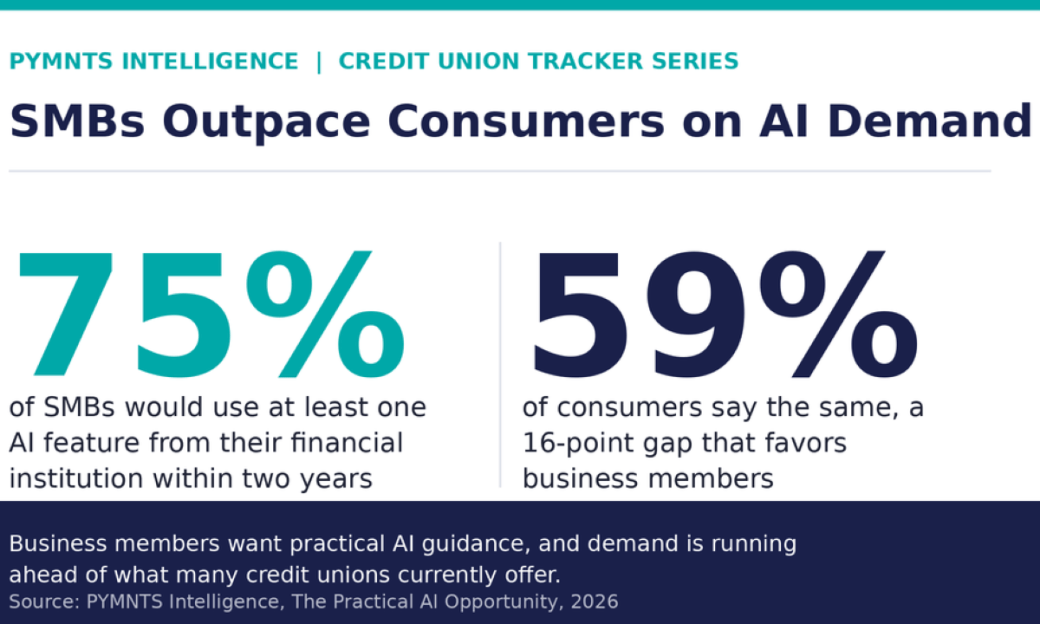
Research from PYMNTS Intelligence and Velera finds that 49% of credit unions view AI as a tool for acquiring customers. The research also shows that small and mid-sized businesses want practical financial guidance from their credit unions before adopting more advanced automation.
4:00 AMPYMNTS
4:41 PMFinextra
Your Best Customers Might Already Be Banking Somewhere Else
Summary
The article argues that banks may be misreading customer loyalty when they conclude that business is stable. Customers can maintain a primary relationship elsewhere while still using a bank for selected products or transactions.
The decisive risk is not visible attrition but declining relevance: customers may remain on a
Unlock the full First Pass Analysis to get a better understanding of why this story matters
Why it matters
A bank can appear healthy while competitors quietly capture its most profitable customer relationships.
The next payments battleground is behind the checkout
Summary
The article argues that consumer payments have become increasingly seamless across phones, wallets, and local payment methods. Competitive advantage is therefore moving from the visible checkout experience to the infrastructure and capabilities that support it.
As payment choice becomes easier for customers, merchants and providers will compete over routing, authorization,
Unlock the full First Pass Analysis to get a better understanding of why this story matters
Why it matters
The next payments winners may be the firms improving transaction economics behind the interface rather than redesigning the checkout screen.
Did fintech Wise take a beating in the media for not getting a US banking licence?
Summary
Wise was denied a US national trust bank charter, creating negative news for the fintech. The article examines how Wise handled the setback and the reputational consequences of the decision.
The denial limits Wise's immediate ability to expand its US regulatory footprint through a national
Unlock the full First Pass Analysis to get a better understanding of why this story matters
Why it matters
A licensing setback can affect a fintech's growth narrative even when it does not directly threaten its existing operations.
ICE posts strongest quarter for mortgage tech since 2022
Summary
ICE Mortgage Technology generated $557 million in second-quarter 2026 revenue, up 5% from a year earlier. Operating income reached $45 million, producing an 8% margin and the segment's strongest quarter since 2022.
The results show a modest recovery in ICE's mortgage technology business after a prolonged housing
Unlock the full First Pass Analysis to get a better understanding of why this story matters
Why it matters
ICE's rebound suggests mortgage technology is stabilizing, but the 8% margin shows the recovery remains measured rather than cyclical boom conditions.
Appli said Connect Credit Union has selected its AI-powered financial calculator to help members explore loan options online. The tool is designed to make borrowing decisions more interactive.
The deployment shifts part of the loan education and decision process into a digital self-service
Unlock the full First Pass Analysis to get a better understanding of why this story matters
Why it matters
Credit unions are using AI and interactive calculators to compete for borrowers before they reach a loan officer or a comparison platform.
Mastercard and Amex Turn B2B Payments Into a Living Control Layer
Summary
Mastercard and American Express are pushing B2B payments beyond faster processing and settlement. Their moves point toward payment systems that embed controls, rules and oversight into how companies authorize and manage transactions.
The competitive shift is from payment speed to payment governance. Embedding controls into transaction infrastructure
Unlock the full First Pass Analysis to get a better understanding of why this story matters
Why it matters
B2B payments are becoming embedded operating infrastructure, which could expand card networks' influence over corporate financial decisions.
Payments modernisation starts with deciding what the bank should own
Summary
A European payments study by BCG found that most surveyed banks see payments modernisation as urgent. The article argues that modernization should begin with a clear decision about which capabilities banks must own and which they should source from partners.
The key change is strategic rather than technological: banks must define their role in the
Unlock the full First Pass Analysis to get a better understanding of why this story matters
Why it matters
Banks risk spending heavily on modernization without improving their position if they do not first decide which parts of payments are strategically essential.
FundCanna CEO Adam Stettner argues that cannabis businesses remain underserved by traditional lenders and require financing built around the sector’s specific risks. He presents disciplined underwriting, active risk management and tailored products as the basis for lending into that gap.
The opportunity depends less on finding demand than on pricing regulatory, legal and operating risk
Unlock the full First Pass Analysis to get a better understanding of why this story matters
Why it matters
Specialized underwriting could make cannabis finance more scalable without treating regulatory risk as a reason to avoid the sector entirely.
UniCredit, Accenture, and IBM join forces for pan-European banking expansion
Summary
UniCredit, Accenture, and IBM have formed a long-term technology partnership to support UniCredit's expansion and operations across the 13 European markets where it operates.
The partnership gives UniCredit a coordinated technology platform for scaling across a fragmented regional footprint.
Unlock the full First Pass Analysis to get a better understanding of why this story matters
Why it matters
Pan-European banking growth increasingly depends on technology integration as much as on balance-sheet capacity.
The article argues that better cross-border payment infrastructure is improving the movement of money in global travel but does not solve the full settlement problem. Faster payments address speed, while broader operational and reconciliation challenges remain.
The key shift is from payment speed to end-to-end settlement efficiency. Travel companies still need
Unlock the full First Pass Analysis to get a better understanding of why this story matters
Why it matters
Faster rails create limited value if travel businesses still face costly, fragmented back-office settlement processes.
FinregE publishes framework in preparation for FCA's 2026 Cryptoasset Regime
Summary
FinregE has published a framework designed to help digital asset firms prepare for the UK's planned 2026 FCA cryptoasset regime. It targets what the company calls an execution gap between regulatory expectations and firms' operating processes.
The approaching regime shifts preparation from interpreting rules to proving that compliance works in daily
Unlock the full First Pass Analysis to get a better understanding of why this story matters
Why it matters
Crypto firms face a compliance test based on operational evidence, not policy documents alone.
Why Regulatory Licenses Mask Root Operational Vulnerabilities at Scale
Summary
The article challenges the view that regulatory licenses are fintech’s ultimate competitive moat. It argues that licenses can coexist with operational weaknesses that become more damaging as a company grows.
A license proves permission to operate, not the ability to manage controls, technology and processes
Unlock the full First Pass Analysis to get a better understanding of why this story matters
Why it matters
Operational capacity, not just regulatory permission, increasingly determines whether a fintech can scale safely.
The article argues that businesses need clear rules and decision rights before deploying AI agents or agentic workflows in payments. It frames the move from manual processes to copilots and autonomous agents as a fundamental change in how work is assigned and controlled.
Governance, rather than model capability, is the immediate constraint on payment agents. Firms must define
Unlock the full First Pass Analysis to get a better understanding of why this story matters
Why it matters
Agentic payments cannot scale safely without explicit authority limits and accountability.
Banks Move Credit Decisions to the Transaction Level
Summary
Banks are beginning to connect credit decisions directly to individual transactions instead of relying only on a fixed limit set during initial underwriting. The shift uses transaction context to make lending decisions more dynamically across everyday purchases.
Transaction-level underwriting changes credit from a largely static product into a continuously assessed service. It
Unlock the full First Pass Analysis to get a better understanding of why this story matters
Why it matters
The unit of credit risk is moving from the borrower account to the individual payment.
49% of Credit Unions See AI as an Acquisition Tool
Summary
Research from PYMNTS Intelligence and Velera finds that 49% of credit unions view AI as a tool for acquiring customers. The research also shows that small and mid-sized businesses want practical financial guidance from their credit unions before adopting more advanced automation.
Credit unions can use AI to compete through targeted advice rather than generic automation. Their
Unlock the full First Pass Analysis to get a better understanding of why this story matters
Why it matters
AI is becoming a customer-growth strategy for credit unions, not only an efficiency project.